Stream or order this album here. I was going to say this is a song that operates on multiple levels, but that’s true of the majority of songs most songwriters write. That’s not a meaningful distinction. If I wanted to tell a straightforward story or recount a series of events, writing a song would be a really inefficient way of doing that. However, a song is fairly efficient at conveying bigger abstractions, meta-narratives, or truths that don’t lend themselves to linear narratives. Take a whimsical tune like Bob Dylan’s “You Ain’t Going Nowhere.” I think I understand what this song means, but it would be very difficult to explain it to you. My explanation would be much longer than the original song and would ultimately fall short of the full meaning. Bob Dylan found a remarkably efficient way to convey whatever it was he was trying to express.
Since I have a degree in mathematics, it occurred to me that there is a mathematical analogy here. I couldn’t quite find the right one, so I asked a friend who is better with these things. Here’s what she said:
It’s a bit like the concept of multiple orders of infinity in mathematics-how some infinities are larger than others, even though both are endless in their own way. The ideas and emotions expressed in a song can be infinite in depth and resonance, encompassing layers of meaning, memory, and association that can’t be fully captured by the more countable, sequential “infinity” of linear language. Trying to translate a song’s meaning into prose is like trying to line up all the infinite points on the continuum between 0 and 1,with theinfinite counting numbers: you can map some of it, but there’s always a vastness left over—something untranslatable and uncontainable. Songs, then, are a higher order of expressive infinity—able to hold contradictions, ambiguities, and emotional truths that linear explanation can only ever approximate, never fully enclose.
“Everybody Get a Fucking Day Job” operates on many levels. On one level, it’s a direct reaction to the COVID shutdowns. I wrote this in early May 2020, after all shows were canceled and everyone in the live music business suddenly needed a day job, which, in music speak, means a job outside the music industry. Like many families impacted by the lockdowns, my wife and I lost 80% of our income. Ironically, Cracker was in Alaska on March 13, 2020, and probably played one of the last shows in the US due to the time zone. May was a dark time. It was clear there was no way to stop the spread of the virus, but there was little sense of whether the effects could be mitigated or contained. The damage to society and the economy was unclear, and most people were quite pessimistic. This song expresses that pessimism, delivered with some fatalistic humor.
On another level, it’s about what happens when a band breaks up. A blunt, comical accounting of what happens when the party is over. The tour van sputters to a halt. There’s no more money coming in. The label’s tour support ends, the recording advances disappear, and in the case of Camper Van Beethoven, because we breached the terms of our tour support agreement, our royalties also stopped (at least until the tour support deficit was recouped by songwriting royalties). Everybody has to get a job. Some of us waited tables. Others tended bar. It’s quite the comedown. And while this might feel like the biggest insult—especially if your identity is wrapped up in being a musician who can draw an adoring audience—it’s not the biggest insult.
The biggest insult is yet to come. It’s when you move on to your next project or new band. You might even manage a new record deal, and it’s possible you can get a few people to care, but unless you are extraordinarily lucky, as the song says, “Sorry man, no one gives a shit.” The song is a reminder that the magic of a band is often greater than the sum of its parts. Alone, we’re just people again, stripped of the collective identity that made us special. This isn’t meant to be bitter, no, it’s about embracing humility, finding dignity in starting over, and discovering resilience and humor in disappointment. It’s about embracing the ordinary after chasing the extraordinary, so that one day you might use the experience to reinvent yourself.
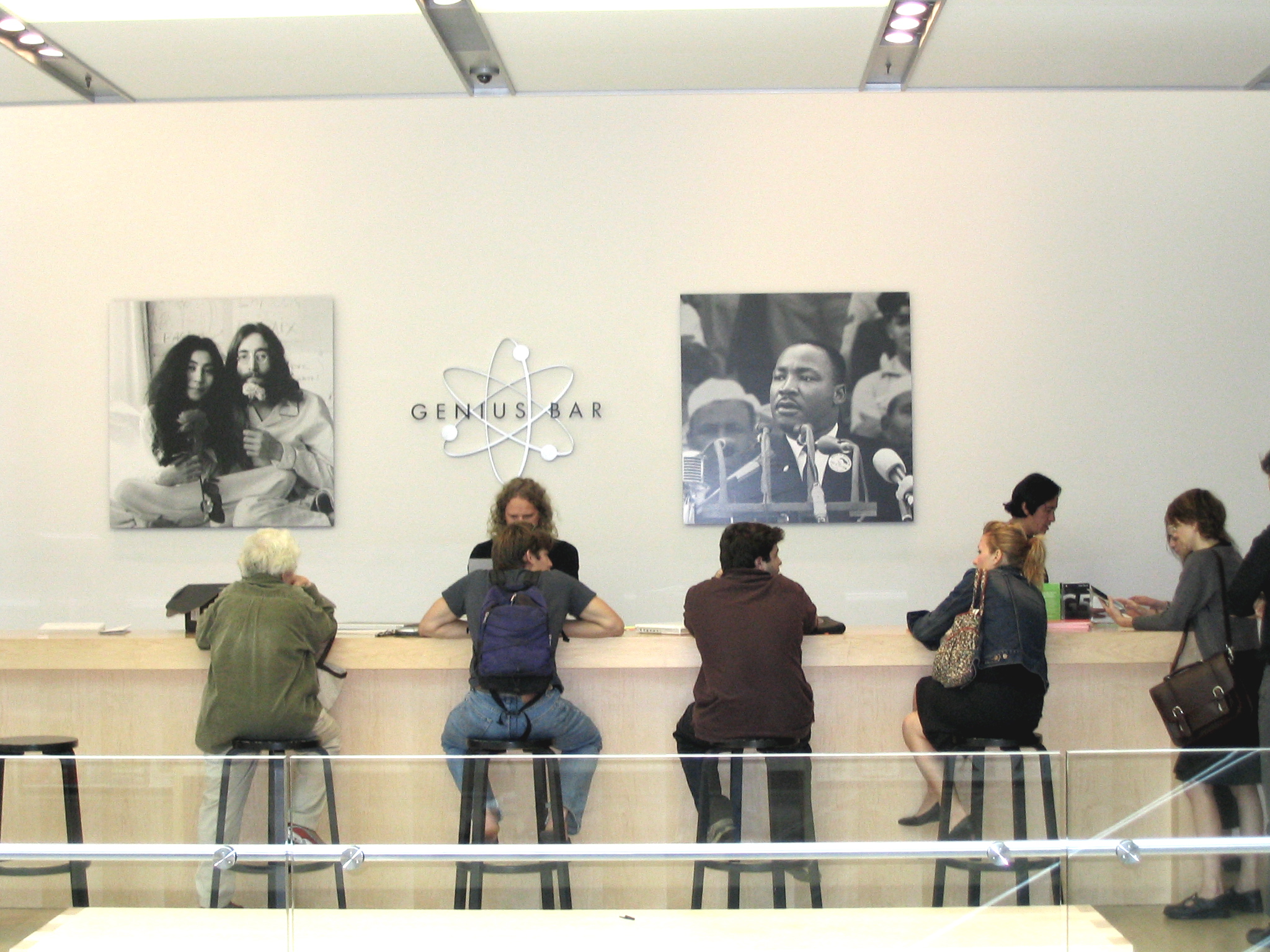
Everybody get a fucking day job None of you are better than the rest Everybody get a fucking day job Wait tables tend bar Push a broom wash a car Everybody get a job Apple Store Genius Bar
Everybody get a fucking day job Sorry man no one gives a shit Everybody get a fucking day job Paint houses spread tar Web design teach guitar Everybody get a job Apple store, Genius Bar
Everybody get a fucking day job In the universe you’re just a tiny speck Everybody get a fucking day job Wait tables tend bar Push a broom wash a car Everybody get a job Apple store Genius Bar
Everybody get a fucking day job You are not as good as you have all been told Everybody get a fucking day job Paint houses spread tar Web design teach guitar Everybody get a job Apple store Genius Bar
++++++++++++++
David Lowery: guitars and vocals Luke Moller: violins and viola Velena Vego: claps and castanets
We really hate your guts And we will never be your friend again We really hate your guts And we will never be your friend again
The song “We Hate You” recounts Camper Van Beethoven’s final days on tour, culminating in the band’s breakup. The first verse is set in mid April 1990, during a ferry ride from Denmark to Sweden. The band likely played a show the night before in Copenhagen, as we made port in Malmö. This was before the Øresund Bridge connected Denmark to Sweden, so the ferry was a large industrial vessel, akin to a floating Greyhound bus station. It was gloomy and unromantic.
By this point, the band had been touring for about three months in Europe, or roughly eight months worldwide, having been on the road almost non-stop since the previous August, with only a brief break from Thanksgiving to New Year’s Eve. The novelty of traveling by sea ferry had worn off long ago, probably around 1987 during the bands second European tour. Three years later no one was looking forward to a cold early morning ferry ride across the Baltic, especially me, as I was hungover.
The ferry’s cafeteria served peculiar Scandinavian breakfast items that Chris Pederson had previously dubbed “Viking Sushi,” which may have included eel. Faced with a long line of German truckers and the unappealing food, I decided to skip breakfast and head to the duty-free shop. I picked up a carton of Marlboro Reds and some chocolate with hazelnuts, grabbed a coffee from a machine, and went up onto the deck.
The sun was particularly bright that morning, but it was cold, with ice still visible in the shallow water along the shore. A group of Swedish men, clearly returning from partying in Copenhagen, were sitting on a deck box containing lifesaving equipment. Occasionally, one of them would stand up and vomit over the railing, adding to the bleak atmosphere.
I alternated between deep drags on my cigarette and sips of machine coffee. A seagull joined me, hovering almost stationary to my left, likely hoping for food. I turned and tried to blow a smoke ring at it, but the ring instantly disintegrated in the headwind. The gull protested with a cry, then angled its wings and shot 20 feet into the air and aft, landing near another group of travelers. Maybe they had some food.
It’s a bright April morning Looking out at the Baltic Sea Swedish drunks are heaving Over the rails I’m headed down to duty free To buy some cigarettes Hazelnut chocolate from Germany
I was up on deck by myself because things were really tense with the other band members. I’m sure I wasn’t pleasant to be around. I had started taking any complaints about the tour personally. Whenever someone griped about the long drives or the hectic promotional schedule, I’d snap and say mean things like, “You’d just be sitting on your asses smoking weed back in Santa Cruz.”
The ship put in at Malmö What an ugly Swedish town As if to make the point A seagull crapped on the van I know you think I’m an asshole A thankless taskmaster You could have stayed home in Santa Cruz smoking weed
I felt guilty and defensive because, in a way, they were right. The touring schedule was overkill. I had pushed the band hard to go on a global tour for this record. I viewed it as our moment, both creatively and commercially.
Commercially, we were finally being played consistently on commercial radio and had made our way into regular programming on MTV. This was our chance to expand our fanbase and maybe finally make a decent living—not get rich, but make a decent living touring. Despite appearing successful to our friends, we weren’t selling many records, and touring was mostly about breaking even and generating record sales. No one made money touring, which is why concert tickets were $8. I wanted to be able to buy a car or maybe rent my own place without roommates.
Creatively, this was also our moment. There is a fair amount of revisionist history about the record we were touring for, Key Lime Pie. Although it is now critically acclaimed, the reviews were mixed when it came out. Many critics and fans felt the dark tone of the record was off-brand, as they were used to our off-kilter, lighthearted psychedelic weirdness. This album wasn’t that. I felt like this record was the one that would finally get folks to consider us a serious band. It was the next stage in the evolution of the band, and the tour was helping us reach that next stage.
The band was right—the tour was brutal. A few weeks earlier, after our Vienna show (there’s a fantastic live bootleg recording on the live music internet archive), Chris Pedersen, Victor Krummenacher, and I came down with a terrible virus. It was almost like hemorrhagic fever; our fevers were so high that our lips cracked and bled. We sweated it out during a 16-hour drive to Italy.
It was also clear that the band had begun to really dislike me. I wasn’t being paranoid; it wasn’t just everyone being tired from the tour. When we finally arrived in Sundsvall, everything came to a head. At the venue, Morgan started mildly complaining about the hotel, a Euro guesthouse with a shared bath down the hall. I lost it and threw the deli tray at the wall. The next morning, everyone was gathered in the breakfast area when I got up. It was obvious something was going on.
“What’s up?” “We’re going home.” “You mean the tour’s over?” “No, the band is over.”
When I woke up that morning, I knew I needed to apologize for losing my temper the night before. I did so now, hoping it would defuse the situation, but it didn’t. I then tried to reason with them, taking various approaches. They all failed. Finally, I appealed to our sense of shared sacrifice, saying, “We have accomplished so much. This is an amazing band we have built. We can’t just throw it away.” Victor, with his typical flair for the dramatic, put a bullet in the discussion:
“We really hate your guts and we will never be friends again.”
Well ok then.
Howie, our tour manager, eventually managed to get the guys to play one more show in Örebro because he literally didn’t have enough cash on hand to get us back to London. So we played one more show and started the three-day drive back to London. Chris, Greg, and Victor managed to get someone back in the States to buy them tickets from Copenhagen to the US. I rode in the miserable van back to London with David Immergluck, Morgan, and the crew. That was it.
When we arrived Sundsvall You thought the hotel not good enough I lost my shit And clearly took things too far Played one last show in Örebro Blew off the UK dates You put your tail between your legs And headed back to Santa Cruz
We really hate your guts And we will never be your friend again We really hate your guts And we will never be your friend again +++++++++++ David Lowery: vocals and guitars Luke Moller: fiddle
The Eurail Pass, originally known as the Europass, held special significance for many in my generation. It was offered by a consortium of European rail companies to promote tourism. The concept was simple: you purchased this pass and could hop on and off nearly any train in participating European countries, traveling almost anywhere you desired. Naturally, it became quite popular among American college students of my generation. In my song, I use the Europass as a broad metaphor for my decidedly hedonistic tour of Europe with Camper Van Beethoven. I had just broken up with my long-time girlfriend (referenced in the song “Mexican Chickens”), and thus began a period of indulgence and misadventure.
I took a red-eye out of L.A. To London Heathrow The fucking Columbia Hotel With a bath down the hall Now I’m drunk in the bar On the floor looking for Fifty pence to make a phone call Down the hall Pretty please look at these Mrs V you could be my spirit animal For a while
The song begins with me drinking at the infamous and somewhat seedy Columbia Hotel in London. Originally, the Columbia Hotel was a collection of five Victorian townhouses that served various purposes over the years, including residences for opium dealers, merchants, and generals. During World War II, it functioned as a Red Cross hospital run by Lady Randolph Churchill. In the 1960s, it became an Air Force officers’ club. By the late 1970s, it had transformed into a “rock and roll” hotel where touring bands stayed.
By the late 1980s and early 1990s, the hotel’s bar was the place to be after shows let out. It was often filled with members of several bands, their crews, entourages, and various hangers-on. In the mid-1990s, Oasis famously trashed the place and was permanently banned. As I mentioned, it wasn’t a glamorous hotel. Performers stayed there because it had a rock and roll vibe. The cheaper rooms had shared baths, and most rooms didn’t have phones, certainly not for international calls. In the hallway off the lobby, there was a bank of pay phones. To make a call back to the States, you needed a teacup full of coins to continuously feed into the phone due to the high rates. There was invariably a line of foreign musicians waiting to call their girlfriends or wives back home. In the song, I can’t find any change to call a girl back in the States, so I start hitting on a random girl in the bar.
If I make it out the other side I will be a king and you will be queen But that’s only if I make it out the other side it’s totally unclear that I will ever get my shit together If I make it out the other side I will be an archduke and you will be some kind of lady If I make it out the other side If I make it out the other side
Musically, the verses are driven by a “four beat,” often referred to as a “Motown beat,” with a snare on each quarter note. However, the chorus cuts the tempo in half and shifts to a standard backbeat, effectively reducing the tempo to a quarter. This deliberate juxtaposition mirrors the contrast found in the lyrics.
In the verses, the mood is gritty and frenetic, reflecting disarray and spontaneity. The lyrics describe fleeting connections with women who are referred to as “spirit animals.” In contrast, the choruses slow down the tempo and introduce grandiose dreams. Here, I imagine myself as royalty, an archduke, a film director, or a cult leader, promising deeper connections with women whom I elevate to titles like queens, ladies, muses, or movie stars. Despite these grand visions, there’s always a warning that I may crash and burn before achieving any of these dreams, leading back to the next verse, which invariably tears down anything built up in the previous chorus. Hence, the line: “I’m so full of shit, I’m in this for what I can get.”
This musical and lyrical structure provides an honest reflection of where my head was during that tour.
Now it’s time for me to go That’s the end of the show Forget the promises made Already on the ship Dover-Calais
So classic girl our little thing In Groningen don’t mean a thing I got a Europass appetite So play guitar and hold the mic And stare straight out into the light Never let them see you sweat or smile
If I make it out the other side I will be a film director You will be my favorite actress If I make it out the other side Though it’s totally unclear that I will ever get my shit together If I make it out the other side I will be the circus master You will be my favorite acrobat If I make it out Promise if I make it out
I’m so full of shit I’m in this for what I can get In a Bochum disco blue light A cheap thrill A good high You in the skinny pants Come with me we can dance Doing lines in der Zandbankbar Come with me to Copenhagen You are now my favorite flavor Ghost you later in the Free Town
If I make it out the other side I will be a cult leader You will be my number one acolyte If I make it out Though it’s totally unclear that I will ever Get my shit together If I make it out the other side You will be my muse And I will always be your faithful servant If I make it out Promise if I make it out the other side
There are a couple of other interesting notes about the recording. I originally recorded the acoustic guitar and banjo years ago in my home in Richmond, VA. It was a piece of music for which I didn’t have lyrics at the time. In the second chorus, there was always some percussion noise, like bells or a tambourine. It didn’t sound bad, so I didn’t try to remove it, but I couldn’t figure out what it was. It wasn’t until we were mixing the track that the engineer, Drew Vandenberg, isolated the sound. He didn’t recognize it, but I immediately knew what it was. It was my son’s old dog, Scylla, standing up and shaking. The very familiar sound of that dog’s tags and harness must have been recorded when I was playing the banjo part.
The pedal steel solo played by Pistol is intentionally not a clichéd pedal steel part. He wanted it to sound more like a saxophone solo. If you listen closely, you can tell. ++++++++++++++++++ Bryan Howard: bass David Lowery: guitars, banjo and vocals Luke Moller: fiddles Carlton Owens: drums Matt “Pistol” Stoessel: pedal steel
While much of the narrative on this record remains strictly factual, this particular song is different. I’ve created a composite and fictionalized parts of the story to protect the privacy of real people. However, I’ve kept the account of my own actions accurate, as it’s important for me to take responsibility and make amends. For this reason there is no background for this song. The lyrics tell the rest of the story, reflecting my journey and the consequences of my actions.
Mexican Chickens Went out the door Into the morning darkness Gravel under foot Heard the screen door gently close
I slid across the seat Steering wheel was cold Tiny icicles on the glass In the corner of the windows
The desert air was dry They were melted in the instant I pulled on to the highway And I began cry
I was leaving her behind Was really for the best I had something deep inside Boundless anger without reason
We all got someone we left behind Cause we’re just weren’t right in our hearts and our minds Yeah we all got someone we were lucky to find in the first place
We all got someone we never treated right We were selfish and the drinking staying out all night We all got someone we were lucky to find in the first place
When she awakes I hope she’s not sad Loved her from the first time I laid my eyes upon her
Got a little house Drove a truck played in a band Got some Mexican chickens And we raised them on our land
Talked of having little girls They’d have their mothers little curls It was more than a dream Yeah one day they’d be real
I played out on the road At first she came along Sang the harmonies mixed the sound Sold the albums and the singles
I hung out in the bar Drinking until the closing time I was foolish I was selfish I’d find her sleeping in the car
We all got someone we left behind Cause we’re just weren’t right in our hearts and our minds Yeah we all got someone we were lucky to find in the first place
We all got someone we never treated right We were selfish and the drinking staying out all night We all got someone we were lucky to find in the first place
She went back to our house To feed and raise the animals We slowly grew apart And I was growing meaner
I drank when I got up Cause motel room was hot Or something stupid I had done I was lonely for my girl
There was always someone else And then there was another I could barely stand myself I was stoned all the time
When I finally came back home She said something changed inside you I smashed a glass against the wall Went out walking in the desert
When I come on back She was sleeping peacefully I knew that she was better Better off without me
The little girls were there I saw their faces in her hair But now it was clear I would never be their father
I put on my coat and hat Slid the dead bolt in the hasp Took one last look back at her I stepped across the threshold
+++++++++++++++
Bryan Howard: bass David Lowery: guitar and vocals Carlton Owens: drums Matt “Pistol” Stoessel: pedal steel Megan Slankard: backing vocals
Packed up my clothes my acoustic guitar In the trunk of the Ford Galaxy My father came out checked the oil and the air and said Son you can always come home
My mother made a Joke about being far away Like i was soldier Away at the war
Acted like I didn’t notice When she brushed away a small tear Said son you’ll be fine
This is another song that does a pretty good job of explaining itself, but I will supplement this with a little more background.
The song opens with the quintessential scene of a young man leaving home, a familiar trope in movies, TV shows, and novels. He packs his belongings as his parents watch, preparing to depart for a job, military service, or college. In my case, it’s college. Specifically UC Santa Cruz. I briefly touch on this in the song, with my mother acknowledging the cliché, yet both parents are visibly saddened by the moment. Typically, my father was the more emotional one, while my mother maintained her classic English stiff upper lip. However, in this instance, they switched roles. My father offered practical advice and took action, while my mother revealed her emotions through a joke about the situation. She essentially said, “It’s a sad moment, but you know what’s really sad? Sending your son off to war. Haha, this isn’t that, but yeah, it’s a little sad.” To be clear, this is not my invention or some poetic license here. This is exactly what my parents did. This is them in a nutshell.
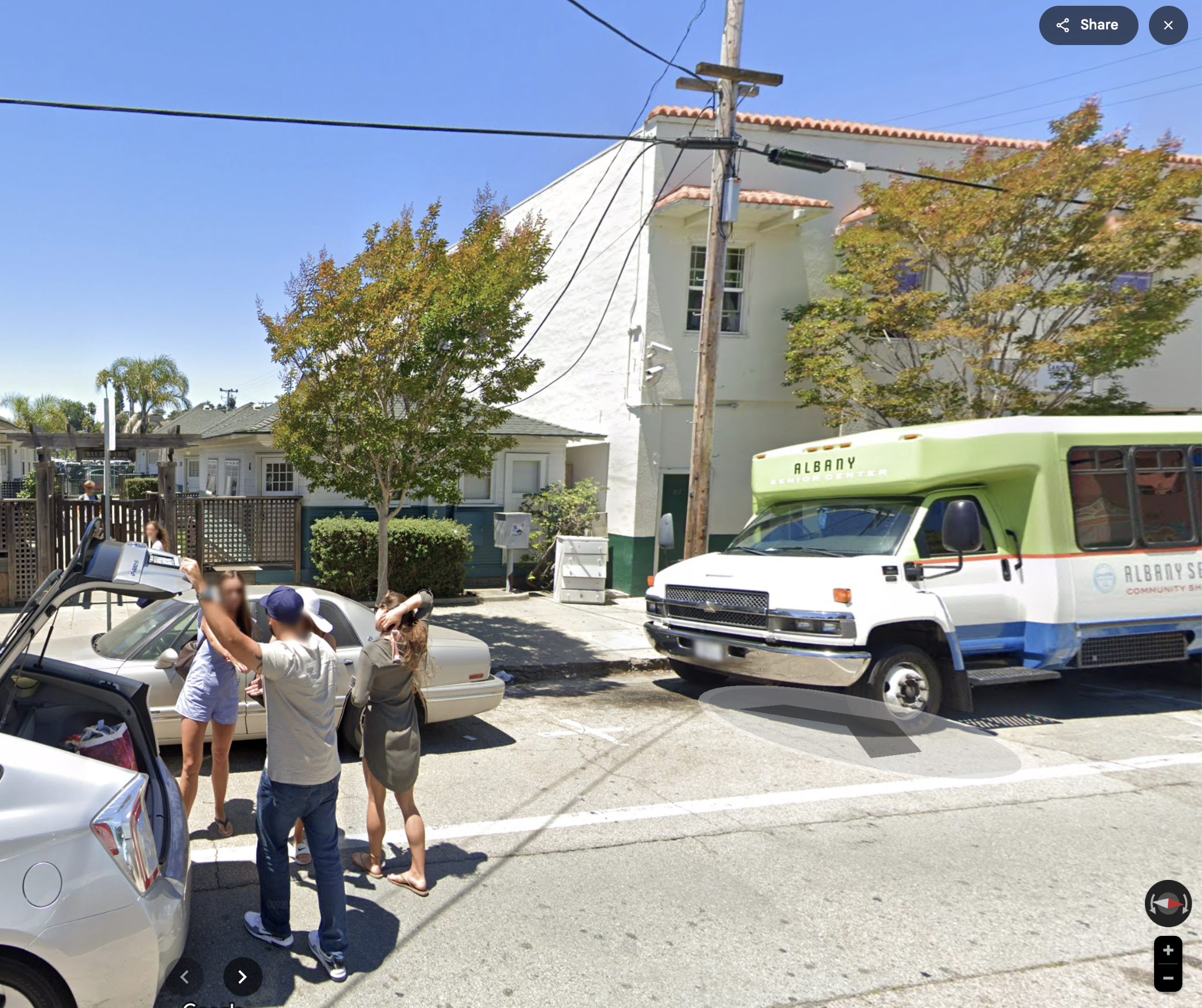
Found the worlds tiniest beach bungalow In the San Lorenzo tidal flats The sea here is always so cold and so grey The sun it doth rarely shines
Rare sunny day in Beach Flats. The bungalow next to the tienda. Image courtesy of Google Street View.
During my time at UCSC, I lived in several places, but the longest and most productive stay was in a tiny two-bedroom bungalow, roughly 400 square feet. This bungalow was part of a complex built in the 1950s as beach rentals. With the rise of air travel, summering in Santa Cruz became less popular due to the typical water temperatures in the high 50s or low 60s. The bungalow was just a few hundred yards from the Pacific Ocean to the south and the San Lorenzo River to the east. The area, known as “Beach Flats,” was where my roommate and I often joked about being the first to go in a tsunami or flash flood. It was also deep in Santa Cruz’s fog belt, where the fog took a long time to burn off each day, sometimes not at all. While it might be sunny at the campus, I’d return home at 3 in the afternoon to find it foggy and gloomy. Despite this, it was a place that allowed me to get a lot of work done, away from the student-populated areas and associated distractions. Except for the start and end of the school year, it was a ghost town by the beach. My roommate, Paul MacKinney, another math major, would finish his homework before me and stand in my doorway, drinking a beer. He’d often hold another unopened one, teasing me by keeping it out of reach until I finished my proofs. Paul was a natural mathematician. I was not. I always had to struggle more than he did. Next door was a tienda selling Mexican specialty food items. Most residents of Beach Flats were Mexican immigrants working in hospitality, and the tienda served them, as well as me, Paul, and his girlfriend who lived above the store. The perks included fresh tortillas and pan dulce. Another benefit of this living arrangement was that Paul would eventually go to his girlfriend’s apartment, giving me the bungalow to myself in the evening to record melodies and songs on my 4-track. Paul and I even had a brief stint in a band called The Jaws of Life, where he played drums. The idea of playing “Wasted” by Black Flag, slowed down and with a hippie vibe, was Paul’s idea, which later inspired Camper Van Beethoven’s version.
I’ll study hard Get a good job Come and meet my girl She might make a good wife Or daughter in law I’ll study hard Get a good job A technology company Out somewhere near Moffet Field
I graduated with a Math degree in the fall of 1983. I don’t mean to brag, but it should be noted that I graduated with highest honors. Not bad considering I was in at least two bands and worked around 30 hours a week delivering produce. I drove a big box truck (as opposed to a tractor-trailer). Some of my shifts were overnight because the wholesale produce markets in Oakland and San Francisco were open from about midnight to 8:00 AM.I always thought it was funny that there was this secret world of late night wholesale produce markets that normal folks knew nothing about.
I had a lot of time to think during these drives. Eventually, I discovered I could write melodies and lyrics while driving. I did this by recording cassettes of the music I’d created and playing them on a boom box. I’d try to come up with lyrics and melody, and when I hit on something, I’d pull out a voice memo recorder and sing the melody and words into it while the boom box played the backing tracks. It took a lot of coordination to do this. I’m probably pretty lucky I didn’t crash, as Highway 17 through the Santa Cruz mountains is treacherous enough already. I can’t tell you how many Camper Van Beethoven songs were written this way.
When spring arrived, the university had recruiters from companies like IBM, GE, and various other large industrial and defense firms visit the campus. I suppose since they were already over the mountains at Stanford, they decided to pay a visit to UCSC as well. Given my academic success, my professors encouraged me to attend. I remember not having a proper suit, only some thrift store suits that I wore to parties or gigs, doing a sort of punk rock/mod thing. I didn’t even have a tie because I didn’t know how to tie one, and I had broken up with the girlfriend who did. As a result, I stuck out like a sore thumb when I showed up. Despite UCSC’s student body leaning hippie-alternative-punk-rock, all the other job seekers seemed to have appropriate suits and sartorial guidance—the benefits of upper-middle-class upbringing, I suppose. One of the recruiters even made a snide comment about my suit.
However, there was one recruiter from an “operations research” company who seemed friendlier. He was dressed more like an Ivy League college professor in a sweater and tweed jacket, or at least what I imagined an Ivy League professor would wear. I thought he might be an ex-hippy. Later, I learned he was wearing the classic late ’70s intelligence community uniform, which explained why he mentioned needing a security clearance to work for them. He seemed impressed that I had excelled in courses like Graph Theory and Abstract Algebra and had written a thesis on Matroids. “Any computational linguistics?” he asked. Sadly, no. In retrospect, I understand why he was asking; computational linguistics is fundamental to probabilistic translation, information search, machine learning and AI. I’d be Silicon Valley rich now if I had pursued it. Regardless, I never received any job offers from any of the recruiters.
When I went to go do my first job interview Knew my suit it was cheap and out of style And The man looked at me like I was Trailer trash and I considered proving him right The sea here is always so cold and so grey And The sun it doth rarely shines Found a job working down Watsonville way on a farm Packing produce in trucks
That was kind of okay. If I’d gone down that path, I probably never would have pursued music, and Camper Van Beethoven would have likely faded out. I wasn’t really worried because, by this time, the farm where I was delivering produce had made me the Production Manager. And however modest the salary I was happy with it as it was more than my father made. The owner, a recent transplant from Silicon Valley (though I don’t think we called it that back then), promoted me because I was pretty good at managing the daily production schedule. More importantly, I had enough programming background to operate and program the computer system he had cobbled together from some Altos MP/M machines and an early Apple Macintosh. Why would a farm need computers? Well, we did grow some crops in the soil, but most of our operation was indoor farming of various kinds of sprouts—Asian-style bean sprouts, alfalfa sprouts, daikon, and others. We had all this lighting, temperature control, sprayers, rotating cylinders, and racks, and the whole thing was automated. We also had semi-automated packing equipment. It was more of a manufacturing facility.
Depending on the type of sprout, it could take 3-8 days to harvest. They grew quickly but spoiled easily. So, the computers handled the usual business tasks like payroll, accounts receivable, and accounts payable. But they also had to help match our short-term harvests with predicted orders. We were modeling a just-in-time delivery system. We built this model across several machines, using an early spreadsheet program (VisiCalc?), dBASE II, and whatever the owner was running on his early Mac.
I met a girl and got her a job on the farm with me. It was nice; it always felt like spring. We lived and worked in paradise—a narrow valley surrounded by redwood forests with a little stream. There were honey bees in the raspberry vines and on the cold mornings the smell of sweet basil and rosemary drifted in from the fields. The light was always a golden green. I had a pretty comfortable groove there for a while. Sure, I got up way earlier than most of my musician friends, and I stayed up way later than any of my co-workers because I was always rehearsing, recording, and gigging with my bands. It was one of the happier times of my life.
In late 1984, we recorded Telephone-Free Landslide Victory with Camper Van Beethoven. In June of 1985, Independent Project Records in Los Angeles released it on vinyl. One day, I got a letter from my cousin in the UK; he had just heard our song on a BBC program. I was overjoyed by this, but as days went by, I began to feel unsettled. In some way, I had always thought of Camper Van Beethoven not as a joke, but as a sort of outrageous experiment—a kind of hail mary. The fact that it seemed to have worked unsettled me. The expression “careful what you wish for; you just might get it” stuck in my head.
I met the boss He was a geek We got along Soon he had me writing dBASE routines for the farm
I had a band It was joke Then it was not We got some real gigs In San Francisco
Went next door to Old the grocery store Bought some refried bean And fresh tortillas
Heated them up on the Flame of the stove Whispered mom I’m living the life ++++++++++++ David Lowery: vocals and guitars
There is a cruel trick that middle school boys play on each other. It usually involves a bully looking for an excuse to beat up another boy. The bully enlists the help of a third person to convince the victim to ask the bully, “How does your sister roller skate?” The victim usually resists because no one wants to ask the bully anything, but eventually, the victim is persuaded by being convinced that this is all good-natured and there is a really funny joke in all of this. Maybe this will produce some goodwill or a friendship with the bully, which is always handy to have when you’re a middle school boy.
Naturally, when the victim asks the bully, “How does your sister roller skate?” the bully replies with feigned outrage, “She doesn’t have any legs,” and then proceeds to beat up the victim. Of course, the bully doesn’t have a legless sister; this was all an arranged provocation to justify a beatdown.
I never had this trick successfully played on me, although I distinctly remember this little pack of assholes headed up by Alex Garcia trying to trick me into this provocation. Alex was 13, already had a mustache, and looked like a boxer. I wasn’t about to ask this kid anything. Also, I already have a sister, Sandra, who is pretty hilarious when she roller skates because she was born with cerebral palsy.
Why do I joke about that? Well, sometimes that’s what siblings do when they have a disabled sibling. You make little jokes about it. Nothing cruel. It’s sort of a way of taking the stigma away. And I mean, we would do it right to my sister’s face. Because she’s the one who most wants the stigma to be gone. I remember my sister Sandra coming to visit me at my dorm room when I was a freshman. I was sitting on the floor with five or six of my friends when she walked in, stumbled slightly, dropped her purse, and then caught herself on the door frame.
“Oh my God, Sandra, are you drunk already? It’s one in the afternoon!”
Two of my friends were in on the joke and fell back laughing. Everyone else was shocked. They couldn’t believe what they were hearing. Meanwhile my sister was laughing so hard she wasn’t even making any noise. I started to worry she was going to collapse onto the floor. It took her like five minutes to regain her composure and speak. Now understand, it was funny to her not because I was comparing her unsteadiness to being drunk, but because there was a group of uninitiated people in my dorm room who really thought I was being an asshole. It’s second order. The in group is having a laugh at the expense of the out group. The in group being me, my sister and friends comfortable with the weirdness around the disability and the out group that is unsure how to navigate in this situation.
Now look, if my sister was severely disabled, we probably wouldn’t have teased her in this way. Nor would would we ever make a joke that was likely to really upset her. There is a line there, impossible to define, but siblings instinctively know where the line is and not to cross it.
Of course maybe this isn’t normal. Some of this may have to do with my family’s rather dark sense of humor. For instance, I remember years later when my mom was suffering from Alzheimer’s. She was living with my little sister Stephanie, and I came to visit. When I walked into the living room, Stephanie had a mischievous look on her face.
“Margaret and I are talking about that man in the picture.” My sister was pointing at a picture of my dad as a young man in his Air Force uniform. My sister was calling our mother Margaret because that day she didn’t know who my sister was. “That’s my husband, Charles.” “David, I told her that’s my father.” “That’s not her father,” my mother said, a little irritated. “Well then, who is my father?” “I have no idea who your father is.” “No idea?” “NO IDEA,” she said loudly, clearly finished with the conversation. “Well, okay then… would you like some tea, Margaret?” “Yes, I would.” My sister got up and headed to the kitchen, but before she disappeared around the corner, she looked back at me, mimicked snickering, and covered her mouth with her hands.
Right up to the line. Didn’t cross it. Well maybe she did but my mother was oblivious.
The dark humor was to take the sting out of the ambiguous loss of a parent who was slowly fading out. I welcomed it, even if it also made me sad.
My sister Sandra was born on my grandma’s couch in Wallace, Arkansas, in 1954. This was a very rural area, and the hospital was quite far away. The doctor didn’t arrive until my mother was deep in labor. The birth was difficult, and at some point, my sister was deprived of oxygen, resulting in brain damage that impaired her motor skills. It did not affect her cognitively, and she has lived a relatively normal life. She has a family, worked for many years, wrote a book about her life, and until recently, she drove and even managed to roller skate a bit.
My sister Sandra is a blessing to our family. Because she required special therapy and often had to attend special schools, my mom focused on her. Much of our family dynamic was built around making sure Sandra was okay. It brought us together and made us close, made us a team. There was also cruelty from other kids. Much of the time, it was directed at me and my other sisters when she wasn’t around, but sometimes it was straight to her face. It was appalling at times. She had to be strong. We had to be strong.
There was also a sort of happy accident for us. When other moms started getting jobs in the 1970s, my mom didn’t. She remained a stay-at-home mom until Sandra was in high school and could drive herself places. So, while the other kids on the cul-de-sac were coming home to empty houses, my mom had food, fresh-baked cookies, and hot tea ready. We were like the idealized 1950s sitcom house in the neighborhood. Eventually, the other kids in the neighborhood realized this, and our house became quite popular. We lived in a mostly Mexican American neighborhood, where the tradition at Christmas time is to make sweets and tamales and share them with your neighbors. My mom reciprocated by making the closest thing she could think of: English sausage rolls. Not pigs in a blanket, not kolaches, but a light, flaky English pastry. It was like something from another planet to the neighborhood kids, and we became known for after-school sausage roll snacks. My sister and her friends from the neighborhood have since “localized” the sausage roll by substituting chorizo for the English sausage. In 2064, there will be a food/travel show that rolls into Redlands, California, and the locals will insist they try the local specialty: a chorizo variety baked in a delicate, flaky pastry. It’s only found in this part of California. No one knows why.
How Does Your Sister Roller Skate
Tell me how does your sister roller-skate It’s a cruel trick teenage boys play on the weak When you ask the answer is “She’s got no legs” Then they kick your ass So let me tell you how my real sister roller-skates
She was born in a thunderstorm on my grandma’s couch in rural Arkansas She almost died before the doctor arrived it was a painful difficult birth She walked with braces and sometimes crutches for the first part of her life` So let me tell you how my sister roller skate
Tell me how does your sister roller-skate My sister roller-skates just fine, she’s got a job a family and she drives She won an employment discrimination lawsuit she wrote a book about her life Tell me how does your sister roller-skate
It was a less enlightened time and she was harassed all the time They called her retard and spastic right to her face and they generally cruel and unkind Me and my sisters we tried to defend her but nothing really seemed to change Until our neighbor Victor broke somebodies’ nose
Tell me how does your sister roller skate It’s a cruel trick teenage boys play on the weak But my sister roller skates just fine And you can’t let the pricks ruin your life Tell me you how does your sister roller-skate ++++++++++++++++++ Bryan Howard: bass
I think this song is pretty self-explanatory so this won’t really be a long blog. tl/dr: You do crazy things as a teenage boy. Then you grow up have your own teenage boys of your own and you hope that they don’t do the same shit that you did.
I was a good kid Tried not to lie much But there are some things You don’t tell mom and dad
I was a good kid, or at least I tried to be. Growing up, I did my best to stay out of trouble and avoid lying to my parents. But as any teenager knows, there are some things you just don’t tell mom and dad. These inevitably involve drugs and alcohol. Sometimes driving cars or motorcycles while inebriated.
Like the bottle in the brown bag And the Ziploc baggy I got from the bikers I worked with downtown They thought I was older Cause I worked the night shift Emptying jukeboxes for Mongols MC
I’ve had jobs since I was 12 years old. Started as a paperboy delivering the morning paper and then shifted to the afternoon paper when I was 14 so I could stay up later at night. As soon as I had my license I bought a motorcycle and shifted to doing a motor route for the Redlands Daily Facts. Eventually I started working at the pressing plant, first assisting the Circulation Manager and then later working in the press room. For whatever reason there were a couple of (honest to goodness) bikers that worked at the plant. I later discovered that this was a trade that was significantly populated by members of outlaw motorcycle clubs and so this was not unusual. One of my many jobs at the paper was to empty the coins out of the vending racks that were the staple of the newspaper trade in those days. There were no real safeguards or controls to prevent someone emptying the machines from skimming money. And someone less honest would have probably done that but I didn’t. After I took over the fact that the machines were producing more revenue than they’d been previously was noted and this led one of the bikers to recommending me to a guy (clearly another biker) that controlled jukeboxes in a number of bars in the Inland Empire. I guess because they judged me an honest non-skimming kid, I was a good candidate for the job of emptying the machines. In retrospect the whole thing was pretty shady because the guy worked from an office at the back of the local Muzak franchise. It was never clear if he worked for Muzak or not. See both businesses are essentially ways to legally publicly perform music in your establishment without needing a license directly from the songwriter organizations BMI, Ascap and Sesac. I can’t quite work it out but there was definitely something not kosher about this arrangement as public performance of music is regulated by The Department of Justice Antitrust Division and I’m sure this arrangement would raise eyebrows there. The arrangement felt like it was part of a racket.
Through these connections I met what would seem to be other members of outlaw motorcycle clubs. The bikers were a rough crowd, but they treated me well enough. They saw me as one of their own, despite my age. This was handy as I was a teenager, and I was interested in things like weed and mushrooms. As was standard practice, the bikers didn’t actually sell this stuff, but they would point you to someone they knew. And likely were paid some sort of tribute from these low level dealers. BTW the way I refer to this motorcycle club as The Mongols. They were not Mongols. Anyone familiar with this subculture will understand why I don’t use the real clubs name.
And that’s basically how I end up with the mushrooms that me and my friend Dale take on an all night Disneyland event they had in those days for graduating high school students. And there really is a Disneyland Jail. It’s a holding area below or behind the buildings on “Main Street.”
Never ride dirt bikes Tripping on mushrooms Through the Dangermond’s orchards In the middle of the night Never climb the water tower Drunk as shit on vodka You just might end up in the county morgue
We ate all the mushrooms In the Disneyland parking lot Dale had a puffy down jacket Put the vodka up one sleeve He looked like a body builder But only on one side So we rolled up a t-shirt Put it up the other sleeve
Never take mushrooms And ride on Space Mountain You just might end up in Disneyland jail Never drink vodka Pass out on the monorail You just might end up in Disneyland jail
Then you get older Have some teenagers You say “Oh my God please don’t do the shit that I did” Stay in the chess club Run for student council Keep playing clarinet in the marching band
Never take mushrooms And ride on Space Mountain You just might end up in Disneyland jail Never drink vodka And pass out on the monorail You just might end up in Disneyland ++++++++++++++++++++++ David Lowery: vocals and guitars
In the late 1960s, my family moved from Spain to Southern California for my father’s next military assignment at Norton Air Force Base in San Bernardino. This area, often called the Inland Empire, was distinct from the Los Angeles metropolitan area, separated by agricultural and ranching lands. When we arrived, it was still a major citrus-growing region. The arid valley, with proper irrigation, was well-suited for citrus farming. Historic orange crate art, the kind you often find framed in antique shops or on the wall of a motel lobby, is usually from farms in this region. The region also housed key industrial institutions crucial for the Cold War, including a steel mill, large railroad yards, defense contractors, and numerous military bases. It was the kind of place where local cowboys, bikers from the steel mill, and GIs regularly clashed in honky-tonks.
My parents were pleased with this assignment because my father’s family had largely emigrated from Arkansas to the nearby Coachella Valley, or “low desert” as the locals called it. The Coachella Valley is now famous for the Coachella Music Festival, but back then, it was known for Palm Springs, a sort of Hollywood in the desert on the west end of the valley, and a vast expanse of winter farmland on the east end, stretching to the Mexican border. The east side of the valley attracted seasonal farmworkers, many from Mexico, but also poor southerners and Oklahomans who came to pick crops in the winter. My grandparents had been making trips from Arkansas to Indio since the munitions plants in Arkansas closed after WWII. In the late 1950s, they moved permanently to Indio. It’s funny because their house was right across the street from the Polo Grounds, where the Coachella Music Festival is now held. If I could go back in time and tell them that one day one of the biggest music festivals in the world would take place across the street from their house, they wouldn’t believe me. “Here? In Indio? In this godforsaken sun-blasted landscape? Here?”
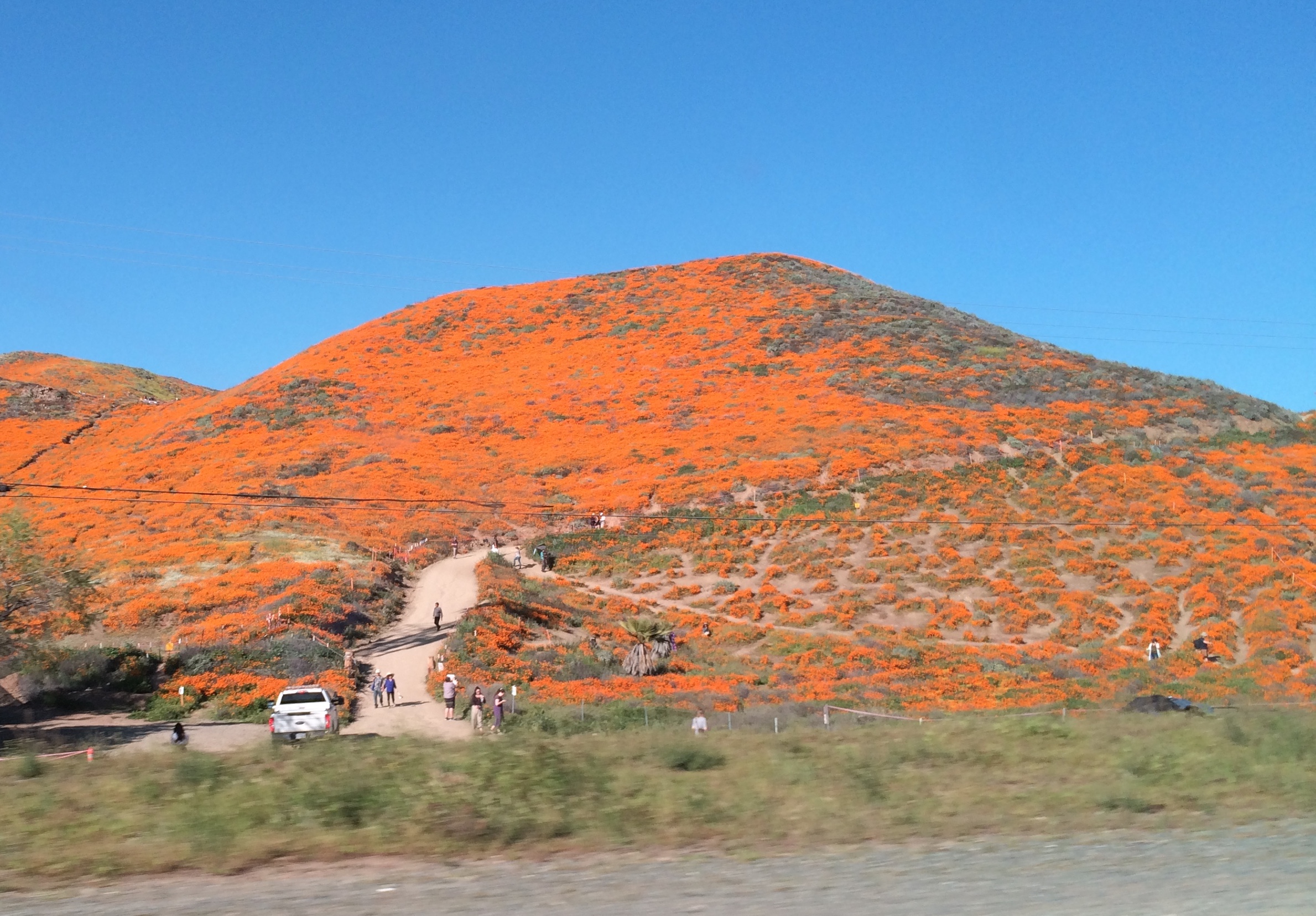
A superbloom is a rare and spectacular botanical event where a large number of wildflowers simultaneously bloom, usually in desert or semi-arid regions. Some of the most spectacular superblooms occur in the Coachella Valley and surrounding mountains, typically after a particularly wet desert winter. The seeds of the wildflowers may remain dormant for years but erupt into blooms when there is abundant rain followed by warm weather. The blooms usually occur in late winter or early spring, transforming the desert from sand into a sea of orange and purple flowers. It’s technicolor, like an acid trip without the acid.
And then just as suddenly, it’s all gone. Dead. Just sand-blasted rocks and relentless heat again.
This was also the Coachella Valley in the 1960s. The west side of the valley was chic, exploding with luxury hotels and golf resorts. This was when Sinatra and other celebrities came here and built their mid-century modernist poolside mansions, swank cocktail lounges, and after-hours nightclubs. Movie moguls, actors, directors, writers, athletes, and mobsters. It was technicolor. The other side of the valley was plainer but just as robust. Desperate dreamers rolled down Route 66 and later Interstate 10 or Interstate 40 to live the good life in California. They didn’t have enough money to live on the coast, so they settled in the Coachella Valley. You didn’t have the ocean, but you had the sun. Well, you sort of had the ocean—the Salton Sea—but that’s another story for another time. These were the poorer cousins to the Californian fortune seekers Joan Didion describes in Slouching Towards Bethlehem. But being poorer wasn’t a problem. Desert land was cheap, and entire subdivisions were thrown up overnight. One aunt and uncle bought their house for $8,000. People worked at gas stations or in farm packing sheds, but managed to buy a car and a house. And if you were still too poor for that, you bought a trailer and moved into a trailer park. It was a superbloom. It was an economic magnet for people in Arkansas and eventually all my aunts and uncles moved here to join my grandparents. And it was glorious for a time.
Each summer, my parents would drive us down to the desert, where we would stay for a week with my grandmother or sometimes with an aunt, uncle, and cousins. My mom and dad would then return to the Inland Empire. These visits were usually uneventful. We often stayed with my grandmother or my aunt, who was a dispatcher for the police department. In the early ’70s, when I was about 13, my last set of cousins moved to the Coachella Valley. My parents decided I should spend a week with them since I hadn’t spent much time around them.
They were wild. I knew it immediately. There was one boy cousin my age, Gary, an older girl named Norma Jean, probably about 15 or 16, and then two older adult boys—twins with red hair. As my grandmother was fond of saying,”Red hair is how God marks the crazy ones.” Indeed. Their dad, my uncle Johnny, had dabbled in being some sort of hellfire-and-brimstone preacher. He was obviously very religious, but he’d also cuss up a storm. A mercurial and volatile personality, not without his charms. (More on him later in Piney Woods)
I arrived on a Sunday, and it was a typical Sunday dinner. We watched baseball and had an early night. In the morning, my aunt and uncle went to work, and the two older twins disappeared for a while but came back shortly with a car—a late-model convertible of some kind. They wanted to take me for a ride in it, but first I had to promise not to tell my uncle and aunt. They told me their father didn’t want them having a car, so they had secretly bought it and parked it a couple of blocks away at a friend’s house so he wouldn’t know. This seemed a little odd to me, but hey, they were an odd family. We drove around for a while, they dropped me off at the house, and then went to park it at their friend’s house.
The next day was also interesting. The twins left for a while and came back with remote control cars for me and my younger cousin Gary. We were having a blast with these in the backyard when we noticed the police in the neighbor’s backyard. My cousin asked them what was going on. “Someone robbed this house. Did you see anybody come over the fence here?” There was a clear trail of footprints that led out of the back of the neighbor’s house across the sand to the fence. My cousin’s backyard had a lush lawn, so even if the robbers had come into this yard, there would be no trail to follow. Gary and I didn’t think anything of it. When my aunt got home, one of the twins asked for the toy cars back. “My pop will be home soon, and he is real strict. He doesn’t like us playing with toys. I’ll put them under my bed.”
The third day was even stranger. My younger cousin Gary disappeared with the twins. I asked Norma Jean where they went. “They went to Sears,” she replied. Norma Jean and I played cards and watched TV for a while, and then the phone rang. It was clear the caller wanted to speak to my aunt, her mother, but Norma Jean was explaining she wasn’t home while also trying to find out why they wanted to talk to her.
Suddenly, Norma Jean said, “Oh, hold on, it looks like she just got home.” She put the phone receiver down on the table and proceeded to act out a radio play, complete with sound effects. The door loudly opening. A greeting to the children in an adult voice, “Mom, someone from Sears wants to talk to you on the phone,” in her own voice. Loud heels across the linoleum. “Hello, this is Mrs. Kelly,” now in an adult voice. The conversation went on for some time, with my cousin Norma Jean expertly playing her mom. Apparently, the boy cousins were shopping at Sears but trying to purchase things with collectible silver dollars. “Well, their grandfather gave them those coins. If they want to spend them on nonsense, that’s their problem.” Amazingly, this seemed to work, and later the twins came home with, among other things, a couple of .22 rifles. These also went under the bed before my uncle came home.
But nothing could have prepared me for what happened the next day. I may have been only thirteen, but it was clear to me what was going on. Without my aunt and uncle around, I didn’t want to be in the house with my insane cousins, so I asked Norma Jean if they could take me to my grandparents’ house since I was feeling homesick. Norma Jean was always sweet, and she suddenly became the big sister. “Of course, baby. I’ll get the twins to drive you over there.” This didn’t sound like the best idea, but I was desperate. The twins left to get their car, but they were gone for quite a long time. Just as I was about to ask Norma Jean to call my grandmother, the twins showed up, each with a car. One was in the convertible, the other in a four-door sedan. I was told to get in the sedan. We followed the convertible, but instead of heading west toward my grandparents’ house by the polo grounds, we headed south into the farm fields. It was summer, and most of the fields were fallow. It was unbearably hot. We turned off the highway and drove down a dirt road through the fields. Up ahead, I could see the Colorado River aqueduct. My cousin pulled the convertible right up to the edge. He got out of the car and walked around to the other side. He was messing with something in a bag, then he threw it into the back seat and came running back to our car, alternately laughing like a maniac and shouting, “Go, go, go!” Flames began rising from the convertible, and our car kicked up a cloud of dust as the wheels spun in reverse in the dirt. I started to sob uncontrollably. The twins suddenly became the best big brothers. “Oh no, it’s okay. Don’t cry. Everything’s all right. You’re not in trouble. You weren’t here. Let’s go to Grandma’s. It’s okay.” The twins were playing the local FM album rock radio station in the car as we drove to my Grandparents. At some point Ozark Mountain Dare Devils came on. “If you want to get to Heaven, you got to raise a little hell.”
And that was it. That was the superbloom. An explosion of unrestrained, misguided young male violence. Technicolor flames. The orange bloom of a burning car on the aqueduct.
And really, that was the end of the superbloom for the Coachella Valley also. By that time, Palm Springs had already begun its decline. It was seedy and shabby around its edges, soon to be the dark muse of a series of pulp crime novels by Joseph Wambaugh. Then the Salton Sea would begin to dry up. As the sea grew more shallow, strong winds would bring the sediment at the bottom to the surface, and some days the whole valley would smell of death.
But it was fun while it lasted.
Storm clouds came up from Mexicali Cast shadows on the Salton Sea Here with my father’s family had settled From Arkansas to the Coachella valley Like the Grapes of Wrath in the ‘70s
My grandfather packed dates Near the polo grounds And he sometimes mowed people’s lawns Grandma was a housekeeper in Palm Springs Or the Bermuda Dunes country club
One summer went to stay with cousins in Indio They were fleeing poverty in Arkansas My uncle was a hellfire Baptist minister My cousin Norma Jean that’s her name she was sweet But her twin brothers trouble for the law
The twins stole a car And they took me to watch them Burn it by the aqueduct Then they robbed the neighbor’s house I was frightened and ran away. Never told my grandfather what they’d done
Dark haired Mary in the eighth grade Her mother was from Mexico Her father was a soldier And she asked me to the dance Sat in the bleachers just held hands One slow dance in at the end
It rained and snowed a lot that winter In the spring came a Super Bloom The desert was a sea of purple and orange flowers From Cabazon on down to Mexico +++++++++++++++ David Lowery: guitars and vocals
Posted in Uncategorized on May 30, 2025 by Dr. David C Lowery
Sometimes I compare my early childhood to that of my friends, my wife, or members of my band, and marvel at how unusual my experiences were, especially my memories of Spain. Sometime in the summer or fall of the year when the sea froze, my father returned from South Korea. He had returned to take us to Seville, Spain. My father, an NCO and specifically a Tech Sergeant in the U.S. Air Force, had received his next assignment. He was part of a small detachment of U.S. Air Force personnel assigned to a Spanish airbase just outside Seville. This airfield is now the commercial airport for Seville, but at that time, it was called Santa Clara. Unlike the larger U.S. airbase nearby at Morón, there was no on-base housing for us. Instead, we lived in a small development on the outskirts of Seville, next to the Coca-Cola plant. We were not fenced off from the local population as many service member families are in other parts of the world. We were constantly in contact with the locals. Peddlers with their carts were always up and down the streets of our neighborhood, selling not just food and household wares, but also offering various services. Seamstresses, cobblers, knife sharpeners, and even a doctor with two nurses in a sort of ambulance came through offering their services.
Spain was very poor at the time, and the wage disparity was so great that even on a Tech Sergeant’s salary, we could afford a housekeeper. We called her Gracias, but that was just the first word of a very long and unusual name, an entire sentence that began with Gracias. The name was the result of some sort of religious vision her mother had; that’s all we knew.
Fittingly, Gracias was very helpful to my mom since my oldest sister, Sandra, was born with cerebral palsy. Although her case was relatively mild, our household always needed a little help (more on this in “Tell Me How Does Your Sister Roller Skate”).
Gracias would play the local radio while she helped out around the house. Mostly, what was played in those days were traditional Andalusian Sevillanas and sometimes pure Flamenco. Sevillanas while similar to Flamenco are more like traditional folk or pop music, while Flamenco, being more improvisational, is edgier and wilder, more like jazz. At least that was the way it was regarded in those days.
My parents, like many military couples, were already deeply into music, mostly American country, blues, and rock. I guess it was the thing that kept them connected to their homes. (My mom, growing up next to a U.S. airbase, was deeply familiar with American music from a young age and regarded it as her native music as well.) Gracias brought Andalusian music into our house. My parents were always quite open-minded when it came to music, culture, and food, and they quickly adopted Flamenco and Sevillanas into their LP rotation.
The Feria de Abril is a giant fair held in Seville each April, where Sevillanas music and dance have become synonymous with the festival. Gracias and my mom made traditional dresses for themselves and my sisters, blending in completely with the locals each April. My two older sisters and my mom even learned a few of the dances. As my mom would say, “we went native.”
My mom had a knack for adopting local accents. Unlike your friend who spent a semester at Oxford and returned to Morristown, NJ, with a slight British accent, my mom’s American accent was flawless. Growing up in the States, most people didn’t realize she was English. When we lived in Spain, Gracias and her friends didn’t realize my mom was English either. When they found out, they suddenly had an urgent story to tell her. Apparently, an Englishman regularly appeared in the local park in the evenings wearing women’s clothing. “Is it a plaid skirt?” My mom asked. Gracias and her friends conferred and said yes, it was a plaid skirt, although they seemed a little unsure. “That’s a Scotsman,” my mom told them. “That is their traditional dress.” A few weeks later, my mom happened to be in the park with Gracias, and they saw “The Scotsman,” who turned out to be a full-on drag queen. Although his long skirt could be described as plaid, it was not a kilt. “Gracias, that is not a Scotsman. That is an Englishman in a dress.”
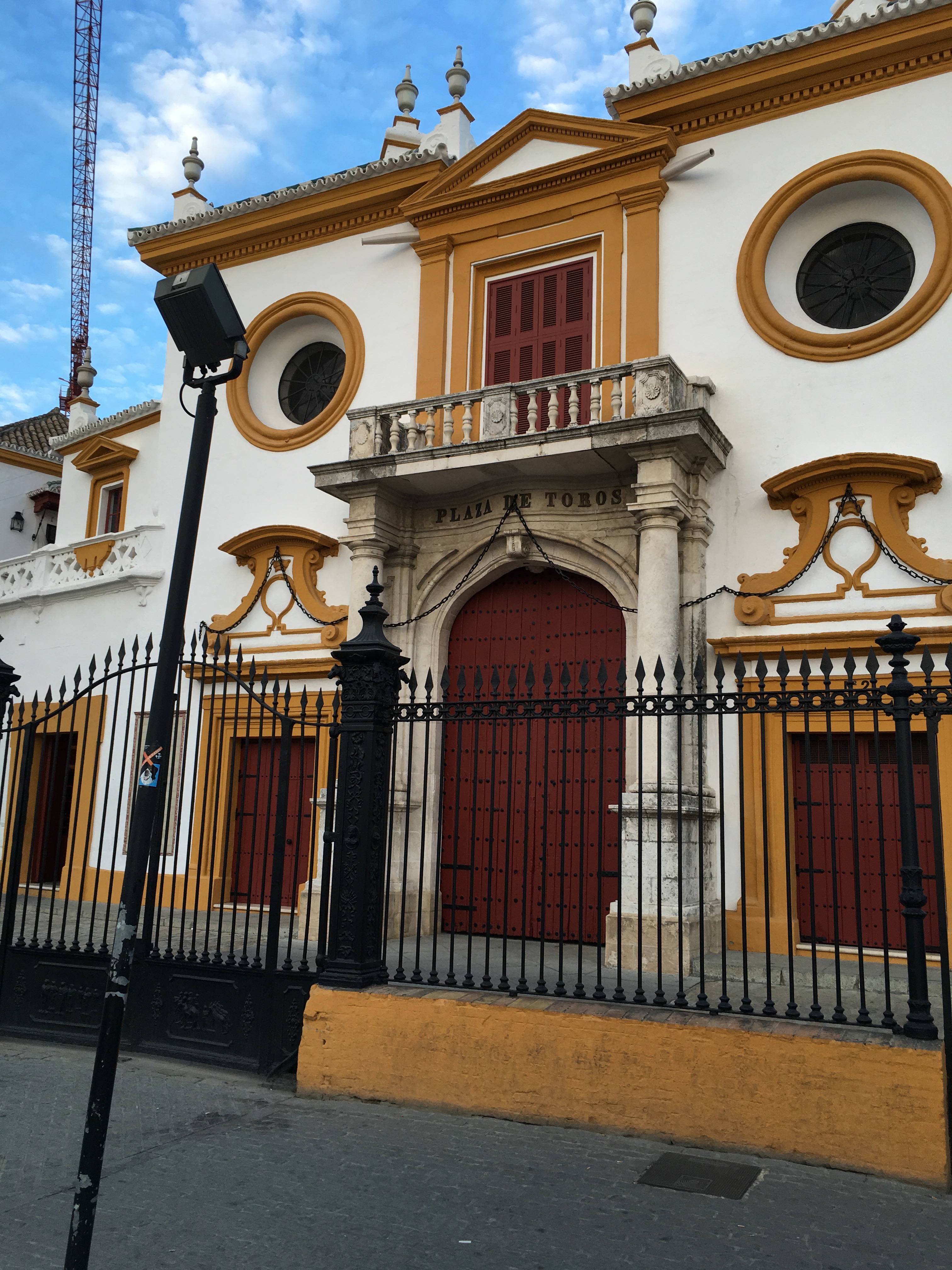
While everything I describe sounds delightful, there was also a dark edge. Bullfights, a cruel sport, permeated this beautiful region of Spain. The imagery was everywhere—paintings, carvings, even on china. Bullfights were televised, and my dad would set up the TV in the courtyard for families to watch. We had toy bullfighting sets and even a children’s book, Little Egret and Toro by Robert Vavra. The story follows a cattle egret who warns a bull about the dangers of the bullring. During a crucial moment, the egret and his friends fly around the bullring, causing the matador to mistake them for white handkerchiefs and spare the bull. Although the book was meant to soften the brutality of the sport for children, it had the opposite effect on me, humanizing every bull. Even egrets made me sad, as I imagined each one had lost a bull friend in the Plaza de Toros.
I remember waking up To the bright sunlight Streaming through the blinds From the courtyard rose Sevillanas And American rock and roll My father in his Sunday best Played records for his friends I tasted sangria from a half full cup And my sister slapped my hand Then we followed on The swelling crowd To the Plaza de Toros
Now come the picadors The crowd gets to their feet and roars Papa do they really kill the bull? Then comes the matador Behind his back a gleaming sword Papa do they really kill the bull?
This all happened while Franco was still alive and governing Spain. Sometimes I hear my friends say things like “we are becoming a fascist country,” and I feel like slapping them. While I may not like the direction of our politics, we are not a fascist country. It’s funny, but I guess you could say I grew up in a fascist country. I was young and an American with a U.S. Air Force family, so I was mostly isolated from the brutality. But even I wasn’t completely insulated. The Coca-Cola plant next to our neighborhood went on strike, and the Guardia Civil, Franco’s paramilitary police, were brought in to put it down. It must have been the summer of ’67, during the so-called Prague Spring. There was unrest all over Europe, and even under Franco, there was unrest in Spain. One day, I was in the old city with my mom. We were shopping when a demonstration began—possibly another labor strike. People were marching and chanting. The city police or Guardia Civil suddenly appeared, and people started running. A shopkeeper motioned us into his shop and rolled the metal door down as the chaos increased outside. We sat there listening to people shouting and police with bullhorns. There were also shots fired; I don’t know if it was tear gas, rubber bullets, or live rounds. But I wasn’t scared because the adults around me were acting normal. The shopkeeper asked me about my toys and fed me sweets. We were rarely allowed Coke, but the shopkeeper gave me a full bottle. My mom, who grew up watching German bombers fly over her house, was laughing and making jokes with the shopkeeper.
In the ancient streets Of the old city Comes a marching crowd In unison They chant and sing Hold their placards in the air The shopkeeper motions Quick come inside Then he rolls the shutters down (And then) the shots ring out The men run and shout The old man gives me a coke
We emerged at dusk And the water in the street was pink Mama do they really kill the bull? Then I thought I saw the matador He held up high a gleaming sword Papa do they really kill the bull?
Next to the Coca-Cola plant and directly across the street from our house was a field littered with the rubble of an old building. It fascinated the neighborhood boys, as there were all sorts of treasures to be found: a rusty iron bar, a piece of melted glass, a sprocket from an industrial machine. One sandy area yielded numerous finds, making it a favorite spot to dig. We discovered a large ornamental metal button from a coat one day, something that looked like a blade another day, the metal rim of a wheel, and part of an axle. Eventually, we found a belt that normally holds bullets. “A machine gun belt,” one boy said, holding it up triumphantly. An older kid disagreed, “It’s too small; it’s a bandolier.” There were no bullets in it.
Everyone started digging more, and someone unearthed a textured metallic cylinder with a wooden handle. A couple of boys were poking at it when an older boy screamed, “That’s a hand grenade!” We all ran off terrified, screaming for our mothers (our fathers were at the base). As we rounded the side of our house, we startled some Roma men who were stuffing sheets and clothing from our clothesline into the back of their cart. They took off running as well.
Someone’s mom called the base, and eventually, some MPs showed up with a work dog. The dog spent some time inspecting the field with his handlers. Eventually, the MPs put a couple of items into the back of their jeep but not before telling us to never go in that field again. We never did, not because we were afraid of the MPs, but because we were more afraid of our mothers. We never learned if it was a hand grenade.
Dug a hole in the ground As boys often do And we found a bandolier And a German made Hand grenade From the Spanish civil war Older boys came along Said go back in the wheat Too much danger to be near And the Romany men Looked on holding piles of sheets And my mother’s blue green blouse
Then came the base MPs The Romany slipped back into the wheat Papa do they really kill the bull? And always the Matador Behind his back a gleaming sword Papa do they really kill the bull?
+++++++++++++++++++ David Lowery: guitar and vocals
Posted in Uncategorized on May 7, 2025 by Dr. David C Lowery
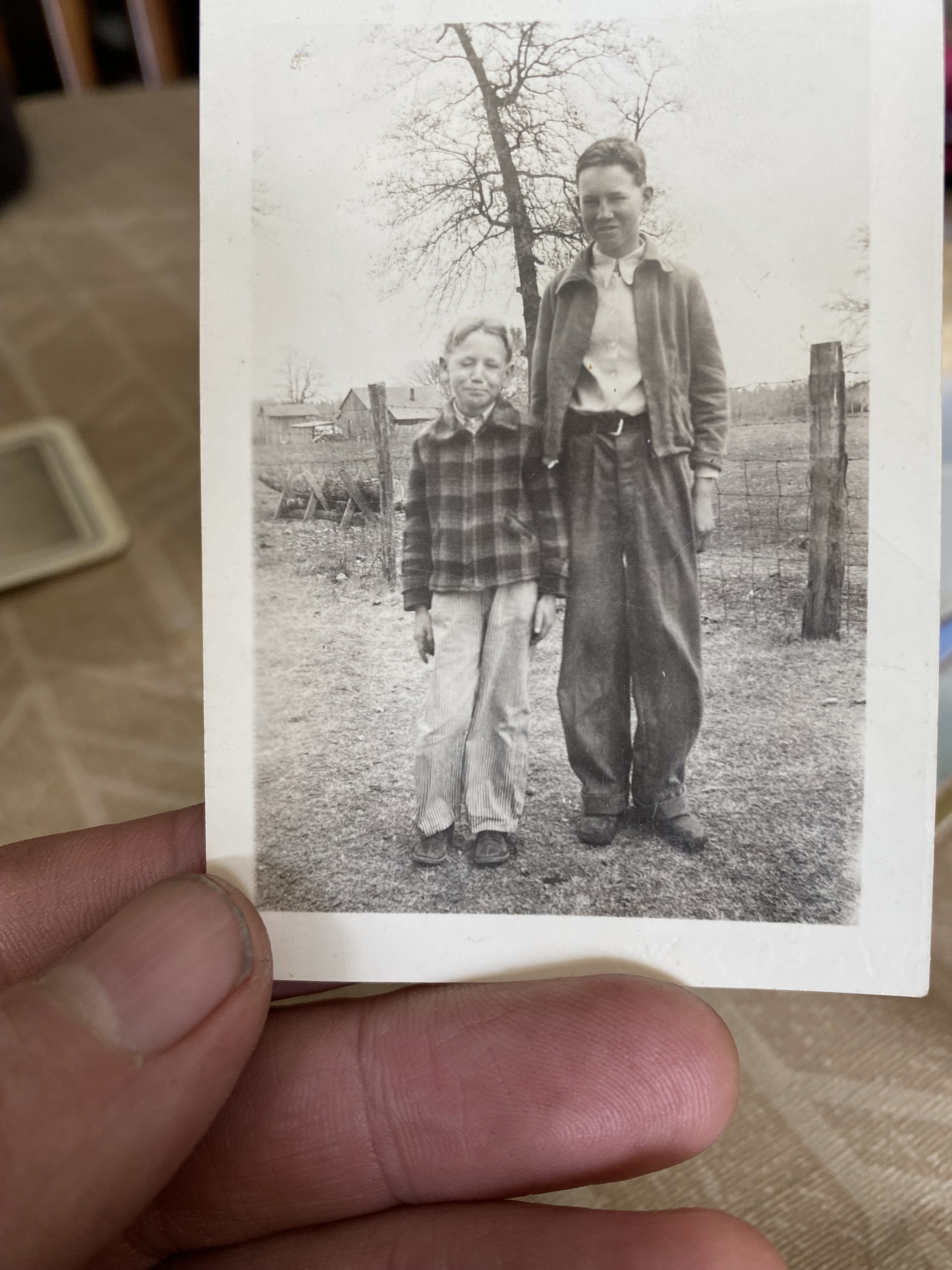
My father and his older brother William C. To listen to this track click here To pre-order this album click here. To Play on Youtube click here “Fathers, Sons, and Brothers” is a straightforward song that earnestly and forcefully preaches brotherly love. While it doesn’t add much to the story, it conveys an attitude reset on my part as I got sober and started reflecting on my actions and behavior over the years. I was working on this song when the shocking footage of George Floyd’s death was aired on national networks, and it served as a way for those of us working on this recording to reckon with his death.
The spark for the song came to me after watching a shared video of a boy’s birthday party on social media. When the first piece of cake is sliced, the boy gives it to his little brother as an act of kindness. The little brother, about five years old, bursts into tears because he adores his older brother and is overwhelmed by the kindness and respect shown to him. This made me think of my father, who surely loved his older brother in the same way. When his brother was murdered, it devastated him (see #99 Piney Woods). Although he never really talked to me about his brother’s murder until the last years of his life, I know it was something he carried with him his entire life. It made him forever a little sad, a little sweet, and always on alert or fearful that something terrible could happen.
There is also an interesting backstory here. The recording is a collaboration with a “sibling” band, The Bellrays, who emerged from the same Inland Empire music scene in California. The two principals, Lisa Kekaula (vocals) and Bob Venom (guitars), are long-time family friends. The recording is a reunion of sorts, bringing together not just Lisa and Bob, but members of Cracker and a far-flung cast of musicians I’ve worked with over the years. This was at the height of the COVID lockdowns, so Luke Moller, who arranged and played the strings, sent in his parts from Australia, and Leith Fleming-Smith played that insane keyboard solo from his home in Nova Scotia.
Fathers sons and brothers Each of us All of us Everyone Fathers sons and brothers Each of us All of us Everyone
A young man filled with pride and vanity Feeling like I must always compete Took me way too long to understand This in my heart Every man is someone’s father brother or son Live by this You will be Infinitely less an asshole
Father sons and brothers Each of us All of us Everyone
Father sons and brothers Each of us All of us Everyone
Help me reach across the chasm Help me hear the signal in the noise Help me put aside All my pettiness and ego Every man is someone’s father Brother or son Live by this You will be Infinitely less an asshole
Fathers sons and brothers Each of us All of us Everyone Fathers sons and brothers Each of us All of us Everyone ++++++++++++++++++++++ Leith Fleming-Smith: organ Bryan Howard: bass Lisa Kekaula: vocals David Lowery: guitars and vocals Luke Moller: strings and arrangement Carlton Owens: drums Velena Vego: Tambourine and shaker Bob Venum: guitars and vocals





 300 Songs
You must be logged in to post a comment.