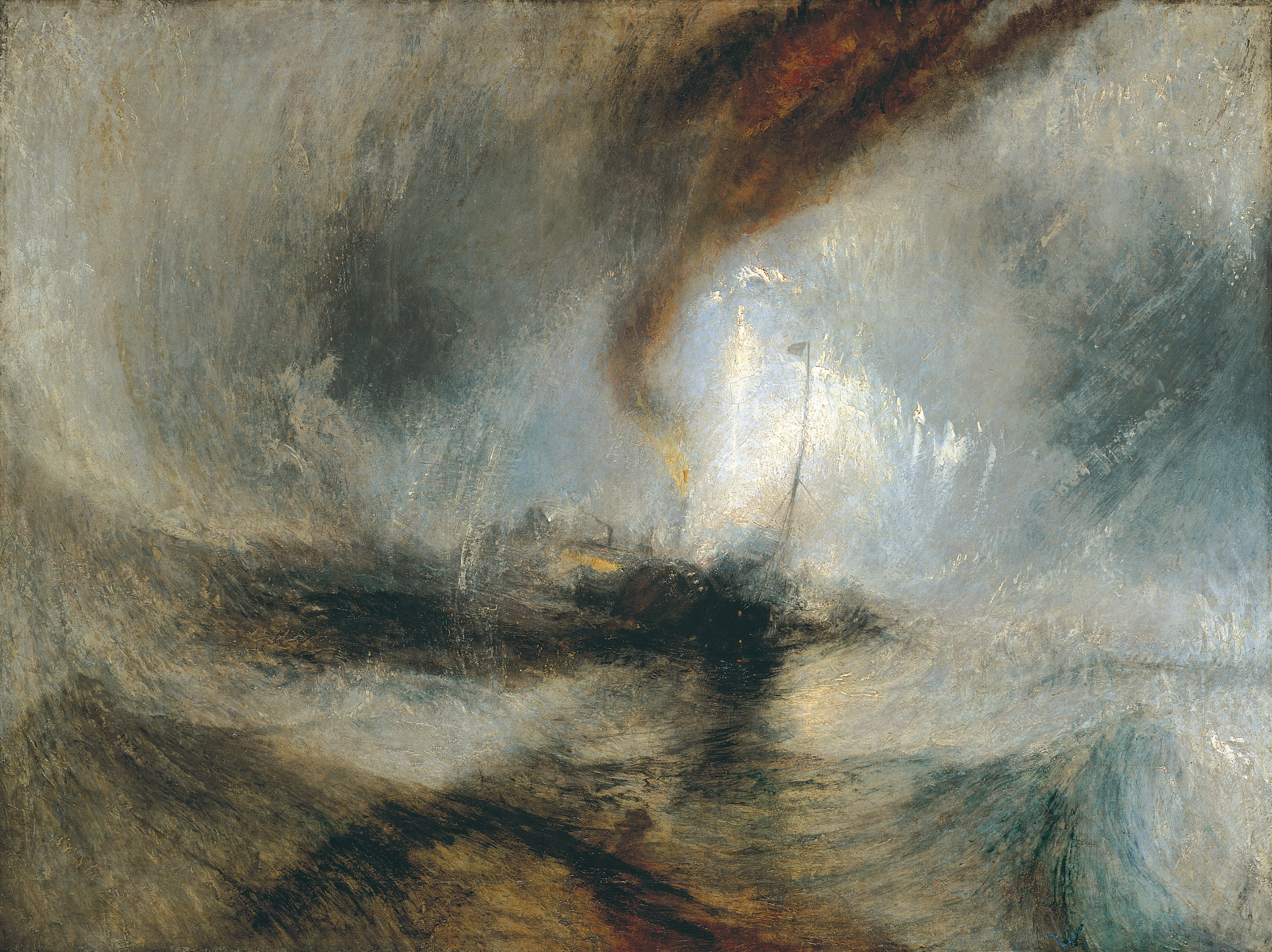
Snow Storm – Steam-Boat off a Harbour’s Mouth making Signals in Shallow Water, and going by the Lead
As I have noted elsewhere, this album project serves as my autobiography. It tells my story while paying tribute to my family, friends, and those who have shared their lives with me. It aims to be entertaining as well! So what better place to start than with my earliest memory: the day the sea froze in Margate, Kent, England, in the winter of 1963.
++++++++++++++++++++++
A different recording of this song was originally released on the limited edition CD album In The Shadow of the Bull. This is a full band re-record with members of Cracker and featuring the talented Megan Slankard. Stream the song here. Pre order the new album here
+++++++++++++++++++++++
My mother was English and grew up in Westgate-on-Sea, a suburb of Margate on the southeastern coast of England. This area is near the famous white cliffs of Dover and just across the English Channel from Calais, France. Like Dover, Margate and Westgate-on-Sea are perched on white chalk cliffs, though perhaps not as impressive. Technically, this chalky area is the Isle of Thanet, though you might not realize it is an island, as it is separated from the mainland by a narrow slough that barely merits a bridge.
The Isle of Thanet is a chalky rock jutting out of the coastal plain into the English Channel, with about ten months of gloomy weather and constant gales. It may not seem ideal for a seaside holiday town, but before cheap Mediterranean flights, it sufficed as a holiday destination.
The Isle of Thanet also served as a muse for the proto-Impressionist painter J.M.W. Turner. His paintings often depict natural scenes like storms at sea or barely visible sunsets through nearly unbroken clouds, with human figures small and inconsequential in the vastness of nature. If you venture to the North Foreland headlands, the tip of the Isle of Thanet, and face the sea during a winter storm, you might better understand his paintings.
Despite its often inhospitable nature, the Isle of Thanet has played a significant role in British history. It was the landing site for the Romans, serving as a key entry point to Roman Britain with forts, custom houses, and strategic settlements. Later, the Saxons established a fort here, marking the beginning of their settlement in Britain. The island remained strategically important, hosting RAF Manston during WWII and later the US Air Force during the Cold War. It was here that my father met my mother. I was born in Texas, but when my father was sent to Korea in 1962, we returned to live with my grandparents in Westgate-on-Sea.
My earliest memory is my mother waking me up to come downstairs to see my father, who was home on leave. This must have been during the Big Freeze of 1963, with snow on the ground. I might be conflating two different days from that time, but I remember being more interested in looking out the window at the snow than going down to see my father, as I only had a vague recollection of him then. Eventually, we all bundled up and went to look at the sea because our neighbors told us it was frozen, which was quite unusual for this part of the UK, although not surprising given the shallow waters.
Another curiosity is Margate Bay’s substantial tidal range. When the tide goes out, fishing boats, sometimes large ones, rest on their keels or sides, which can be surprising if you’ve never seen it before. On that day, the boats resting on their sides were frozen into the ice. When the tide came in, they didn’t right themselves but remained listing. J.M.W. Turner also depicted similar scenes in his sketches, showing large boats sitting on their keels in the mud in Margate harbor. It must have made an impression on him as well.
First thing I remember
I’m looking out at the snow
In some English seaside town
People out on their front steps
Laugh smoke cigarettes
Look out at the frozen sea
Say it ain’t happened here since ’23
I go down into the kitchen
Strange man in a uniform
Holds my mother hand she kisses his cheek
My sisters all down at his legs
Hug and call him pa
He reaches down lifts me in his arms
Puts a silk ball cap on my head says Vietnam*
We go down to see the frozen sea
My sister on her crutches father and me
The boats they lay upon their side
In Margate harbor at low tide
We go down to see the frozen sea
*Try as I might I could never make “Korea” sound melodious, yet Vietnam with the raised second syllable
works for some reason
For my mother, one of the downsides of living on the Isle of Thanet, just 20 miles from France, was being directly in the path of German bombers during WWII. Like many families in southern England, one day the nuns and police gathered them up and put them on trains to the middle and north of England. My grandmother took my mom’s younger siblings to an estate where she served as a housekeeper, but my mom and her older brother were sent farther north alone. The trains would stop in small villages, and local families would come out and select children to live with them for the duration of the war. My mom and her brother spent the rest of the war in the countryside near Leeds. They were far enough from industrial targets to be reasonably safe but close enough to watch the bombings and occasionally inspect the wreckage of German aircraft in the fields. The country family became a second family for my mom and her brother. To this day, it’s not clear to me who is a “real” cousin and who is a “country cousin.” This experience had a profound effect on everyone in her generation. My mom never really forgave the Germans, Italians, and to a lesser extent, the Spanish, as she regarded them as allies of the Germans.
This presented a problem when my father’s next assignment was in Seville, Spain, where he was part of a small US Air Force detachment sent to train the Spanish Air Force. My mom rightfully regarded the fascist government under Franco as the unrepentant remnant of the Axis powers. Over the years, she developed a great love for the Spanish people, especially the Andalusians, but she bristled when we were around the Guardia Civil, as they acted as Franco’s main tool for suppressing dissent and maintaining power. I remember her explaining to me when I was older the significance of the Guardia Civil and the Spanish fascists. It was important to her that I understand the strange circumstances we had found ourselves in.
Braces and crutches
My sister climbs the ramp
Into the c-130 cargo plane
Two airmen get to their feet
Lift my sister in the air
Put her in the seat
Between the two of them
My sister laughs my mother still looked grim
We flew out across the English sea
Over southern France across the Pyrenees
To an airfield just outside Sevilla
La Guardia they greeted us
My mother muttered fascist under her breath
I visited Margate a couple of times with family in the late 1970s. It was still a glorious place to be as a teenager in the summer. Margate still hosted some day-trippers from London and farther north, but the town was definitely past its prime. The amusement park Dreamland was the main attraction. The arcades and the theatre along the promenade were still occasionally lively (see the film Empire of Light). But eventually, even this faded. By the time I returned in the late 1980s (usually on tour with Camper Van Beethoven), it was emotionally and economically depressed. Many of my family had left and emigrated to more prosperous parts of the UK or overseas. When the Channel Tunnel was built, the ferry business in Ramsgate collapsed, and it seemed like this place was forever blighted. But over the last couple of decades, the place has bounced back. Some of it was inevitable as London became absurdly expensive, and people had to find other places to live.
In 2011, the JMW Turner Gallery opened on the seafront, and combined with Margate’s development as a shabby chic getaway for a certain class of London hipsters, it seemed to lift its fortunes.
The third verse of the song is set around this time. My sister and I visited Margate shortly before Christmas. I remember the day we arrived; I looked at the weather app on my phone, held it up to show my sister, and she laughed because the entire week read “High 1 Low 0.” It proceeded to rain and sleet all week. At one point, we were at a pub built into the seawall, having tea on the “smoking patio” so my sister could smoke a cigarette. The patio was essentially a couple of extremely taut tarps strapped down with commercial cargo straps attached to metal rings set in the concrete. To evoke a tropical feeling, part of an old billboard for a Spanish holiday resort from the 1990s was tacked to the wall as a backdrop. A small synthetic Christmas tree with built-in lights stood blinking amidst the palms on the backdrop. The wind was blowing so hard off the sea that the cargo straps occasionally vibrated with an audible low tone, something like a ship’s horn.
We decided to go into downtown Margate to the JMW Turner Gallery because we heard there was a Tracey Emin exhibit. Tracey Emin came to prominence in the late 80s and early 1990s as part of a group of young London-based punk-influenced artists sometimes referred to (somewhat generically) as “Young British Artists.” Tracey Emin was originally from Margate and had recently returned to set up a foundation.
One of Tracey Emin’s most famous works is “My Bed.” It’s basically a wild artist rocker chick’s bed from the 1980s, with empty liquor bottles, an overflowing ashtray, and various personal items of a very private nature. You get the idea. I think it really is her bed. This was the Tracey Emin piece they had in the main gallery that day. This in itself is funny because her art and style are very different from JMW Turner; you would hardly expect this to be on exhibit here. But it was.
It was a Tuesday or something, shortly before Christmas. The place was dead at first. But after a bit, we noticed a commotion. A bus had arrived, and a group of a dozen or so pensioners, perhaps on an outing from a retirement home, were filing into the main room. Eventually, one particularly rough and wiry lady of indeterminate age broke from the group and marched right up to Tracey Emin’s Bed. She stared intently at the bed, cocking her head to one side and then the other, focusing intently on something. Then she spun on her heel and looked around the room. For some reason, she locked eyes with me. Then she flicked a cigarette out of a pack and lit it in what seemed like a single fluid motion—clearly experienced. She stood there triumphantly puffing on it. One of the gallery workers rushed over and told her to put the cigarette out. There was a sort of scuffle and argument, with the gallery worker whispering loudly while trying to take the pensioner’s cigarette, and the pensioner loudly protesting that there was “an ashtray right there.” So in the song I say that this was “Tracey Emin in the flesh” not because it’s Tracey Emin but because this woman was clearly possessed with her spirit.
After things settled down, my sister and I went across the street to the old Victorian-era Kent Market. It’s a quirky little place, authentically painted in garish colors. There’s a woman there who makes really great Cornish pasties. The weather was awful, so we lingered inside as long as possible. The rich colors inside contrasted sharply with the grey outside—the sea, sky, streets, and buildings were all grey outlines in the fog. It was like a J.M.W. Turner painting.
50 years later again at Margate Bay
I’m in the JMW Turner Gallery
Someone lights a cigarette
Ma’am you can’t smoke that in here
It was the artist Tracy Emin in the flesh
In the main gallery her famous bed
We went out across the Margate high street
Into the old market for Cornish pasties
My sister bummed a cigarette
We went back out into the sleet
And the sky was like a JMW Turner painting
Bryan Howard: bass
David Lowery: guitar and vocals
Carlton Owens: drums
Megan Slankard: backing vocals, banjo and keyboards



 300 Songs
You must be logged in to post a comment.