#99 Piney Woods
Stream or order the new album here.
“Piney Woods” ostensibly tells the story of my move from Los Angeles to Virginia, with a stop in Arkansas to visit my grandmother, aunts, uncles, and cousins. But the actual move is the least important part of the story. At its core, this is a song about the murder of my dad’s brother and how that event created generational trauma in my family, with the legacy of racism in Arkansas serving as a kind of coda.
Still, the move itself deserves some mention because it was a complete fiasco. As I’ve noted before, most of my belongings had been stolen while I was in Europe, so I didn’t have much left to take to the East Coast. But even if you don’t have much, uprooting your life and moving 3,000 miles is still a major ordeal. To make things even more complicated, what little I had left was scattered all over Southern California-some with friends, some with family.
I’d convinced John Hickman to come with me. He had a bit of stuff to move as well, but surprisingly not much-just a guitar and a Peavey amp. Even so, it was nearly midnight by the time we finally loaded the last of our things into the U-Haul trailer.
Most sensible people would have waited until morning to leave, but we were about to drive a 26-year-old car across the country. Sure, it had a relatively new engine and a rebuilt transmission, but it was still an old car-and we were towing a trailer. At some point, we realized that since it was August and we’d be crossing the Mojave Desert, it might be smarter to drive at night. That quickly became our plan: cover long stretches after dark. Johnny and I grabbed some coffee-I think at the same Circle K from the “Leaving Key Member Clause”-and headed out of the LA basin into the high desert.
Packed up my Valiant
Station wagon with my clothes
It was almost midnight
When I left Los Angeles
Drove through the desert
On a moonless night
Then I saw the sunrise
The other side of Flagstaff
Drove cross the reservation
With an aching in my heart
Would I see my family
Ever again
Checked into a motel
Gallup, New Mexico
Dreamed about my grandmother
She was speaking to me
The plan was to take a break for a few days in Arkansas, just south of Pine Bluff. My grandmother had recently moved back there with Toni and Wayne, my aunt and uncle. (Incidentally, Aunt Toni’s real name was Marie Antoinette. Unusual, old-fashioned names are a running theme in my dad’s family-don’t even get me started on Sophronia, Nimrod, and General Forest.)
In the late ’80s, much of my dad’s family made a general exodus from the Coachella Valley back to Arkansas. This included Uncle Johnny, the “hellfire Baptist minister,” Aunt Barbara, the infamous felonious twins, and a host of other cousins. Uncle Johnny and Barbara lived about a quarter mile down the dirt road in a ramshackle trailer, while various cousins were scattered deeper into the back country. It was a very humble, very poor area, though not without its own natural beauty. The place sits at the northern end of a region called the Piney Woods.

The Piney Woods is a dense, mostly coniferous forest that stretches across northern Louisiana, southern Arkansas, southeastern Oklahoma, and eastern Texas. Wild, poor, and underdeveloped, it’s home to abundant wildlife and rare species that are nearly extinct elsewhere. Shortly before she died, my grandmother claimed she heard the distinct call of the Ivory-billed Woodpecker-something she remembered from her childhood. I like to think it returned to call her home.
Even today, this area feels more like a frontier than part of a modern, post-industrial nation. While Toni and Wayne worked regular jobs in Pine Bluff for a mill supply company, my Uncle Johnny and his kids lived almost entirely off the land, farming small plots, logging, and fishing.
Come see my grandson
I’m in the piney woods
You’re on your way to Virginia
Come see me son
Come see your family
Your uncles buried in this soil
So you can understand
Where it all comes from
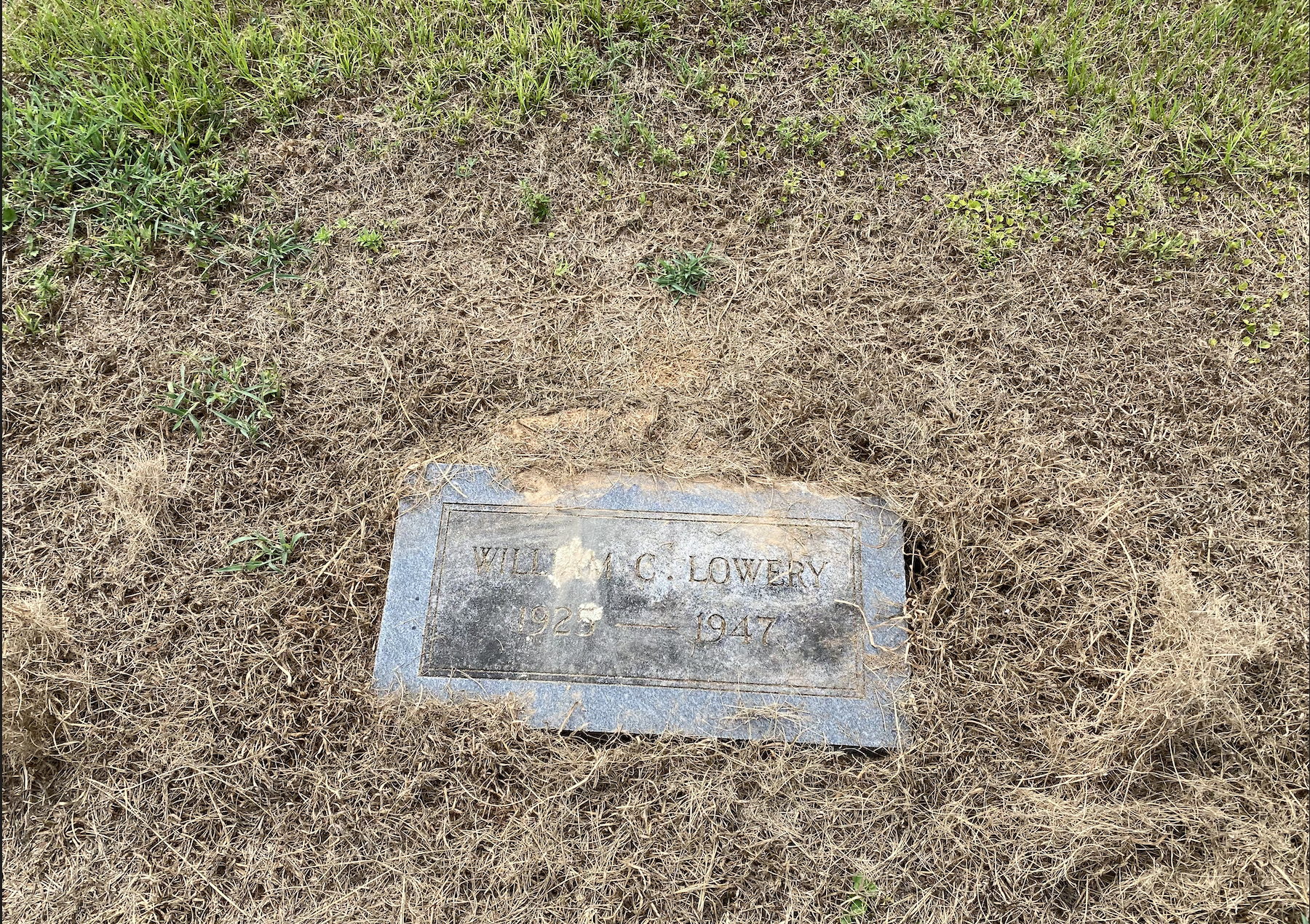
During those few days in Arkansas, I finally had the chance to talk to my grandmother about her life. There was so much family history I wanted to learn before her generation was gone. She was in her eighties at the time. In particular, I was hoping she might tell me about my uncle William C., my dad’s brother, who had died in a small plane crash on their old farm. My dad never wanted to talk about it, and it was clear there was more to the story. And there was.
When I brought up his death, my grandmother seemed almost eager-relieved, even-to finally share the story with me. She started bluntly: “In 1947, my son William was murdered. It was a murder-suicide.” She then described in great detail how the events unfolded. I can’t really do it justice, but essentially, a local pilot owed my grandfather money. It was a bitter dispute. Eventually, the pilot came to my grandfather and said he’d pay what he owed, but wanted William, his oldest son, to accompany him in his small plane to El Dorado, Arkansas-a bawdy former oil boom town to the south. The man promised to bring William and the money back to the farm the next day.
Of course, this was a terrible ruse. The pilot and William C. took off in the plane, circled the farm a few times, then pointed the plane toward the ground at full throttle and crashed it next to the house. My dad and his family watched as William died. This may have even been an attempt to kill the whole family. The reason my grandmother wanted to tell me this story was to explain how the murder created what mental health experts now call generational trauma. This term refers to the psychological and sometimes physiological effects of trauma that are not limited to a single individual but are passed down from one generation to the next.
She and my grandfather were never the same. They eventually sold their property and left that part of Arkansas because of the tragic history and the violence that had occurred there. My grandfather seemed to never sleep. When I was a kid, I remember seeing him sit up all night in a rocking chair at my grandparents’ house in the Coachella Valley. I asked my grandmother if that was because of the murder, and she said, “Likely. He felt responsible.” My father was forever damaged by this as well. He was always beset by anxiety and struggled his whole life, often saying his “nerves were shot” after his brother died. His two older sisters also showed signs of depression and anxiety. I feel like a lot of that anxiety was passed to me from my father, and perhaps from me to my sons.
My wife Velena’s people passed through Arkansas too, though a little farther north, up in the shadowed folds of the Zigzag Mountains. During the lean years of the Depression, her grandfather met his end there-murdered, maybe over a card game, maybe for something even less noble. It makes you wonder about a place, whether the land itself breeds a certain wildness, a lawlessness that seeps into the roots and the rivers. In Arkansas no real city ever really took hold here-unless you count Texarkana, half-in and half-out of everywhere, or nowhere. What you find now are faded boomtowns, hollowed out by time and the slow collapse of oil and timber.
The region is rich in folklore and music about highway robbers, murderers, and all sorts of outlaws. It’s not that there weren’t good people here-there were, and are-but somehow, the darkness always seemed to find its way into every family, touching everyone just enough to leave a mark.
The dark malaise that comes to you
On a bright and sunny day
The feeling that something bad
Could happen any time
It is a family wound
Cuts across three generations son
You carry it inside of you
Just like your father did
My oldest son
Was murdered in these fields
A man came to the house
Owed my husband money
If I can take your son, William
To El Dorado
I’ll bring him back home
With all that I owe
They took off in a small plane
And circled our fields
He pointed the plane downward
it crashed into the ground
As William lay dying
His little brother looked on
That’s what your father carries
It’s inside of you too
And then there is the sordid history of racism in my family, which enters as a coda to the song. What I’m not going to do is what many well-intentioned white people often do when confronting a family history that involves racism or slavery. They tell stories of “the good relative” or create an “ancestral alibi.” These are tales about a great-uncle from Mississippi who defended a black defendant wrongfully accused of a crime, a grandmother in Pennsylvania who stood up to her racist Polish neighbors, a second great-grandmother who was part of the Underground Railroad, or a third great-grandfather who commanded black Union troops in the Civil War. There’s a tendency for white people to share these stories with black friends once they become close. I’ve seen this play out several times in my life, and-as the kids say-it’s a “super cringe” moment. I’m not going to do that—not out of some deliberate effort to avoid it, but simply because, if you go back a couple generations there is little redeemable here.
Although Arkansas was not a major slave state in terms of sheer numbers, it still has a terrible past with racism. If you mention “Little Rock” to anyone in my generation, the first image that comes to mind is that textbook photo of the 101st Airborne escorting nine black students past an angry white mob into Central High School. In my experience, some of the most virulently racist things I’ve ever heard from white people have been in Arkansas, especially in the mountain regions that never had much of a black population to begin with. As black scholars have noted, this may be due to the dominance of a raw, xenophobic brand of racism in these “whiter” areas, as opposed to the more patronizing racism found in the blacker Mississippi and Arkansas Delta regions.
Someone once confidently told me that only 8% of all American households owned slaves in 1860, implying that it was actually quite rare to be descended from a slaveholder. But that’s a questionable conclusion. You have 32 third great-grandparents. Do the math. If your family is from the South, the odds are inescapable-about 30% of all families owned slaves.
That said, I never once in my life heard my dad, mom, or grandmother use a racial slur or behave in an overtly racist manner. Still, my Arkansas family included plenty of racists-some of whom eventually changed, but many did not. Make no mistake: this is the legacy of slavery. My second great-grandfather owned a couple of slaves. His brother was a large slaveholder, which probably explains why Lowery is a common black surname in the U.S. The Civil War wiped out much of my family; many who survived died of typhoid, and those who lived were left deeply impoverished. They held a grudge about all of this well into my father’s generation. My grandfather’s brother was named General Forest Lowery-after General Nathan Bedford Forrest, the founder of the KKK. No one was hiding anything.
So the confession at the end of the song from my Uncle Johnny is not surprising. He isn’t completely disavowing his racist past; he’s simply admitting that he’s ashamed of having been in the Klan. Like he went too far.
He picked up Hickman and me to go fishing, but first he had a long list of errands to run. Occasionally, he would drop the N-word-old school, hard R. What made it so confusing was that most of his errands involved swapping favors and borrowing things from various black men, who called him by his first name just as he called them by theirs. They were all clearly friends of some sort. The one variation was the black pastor who was recovering from chemotherapy. When we stopped by to see if his lawn needed mowing, Uncle Johnny treated him with respect, addressing him formally and using his honorific and last name. I knew what I was getting into when I agreed to go fishing with him. I went anyway because he always had a certain undeniable charisma despite his flaws. He would have made a good cult leader. How could I turn him down? My first wife, Mary, upon meeting him, said, “Poor Aunt Barbara-her fate was sealed the moment she met him.”
There’s a reason I say, “I can’t escape this country”—meaning the Piney Woods and my family here, despite all their obvious flaws. My father’s family has always been, and still is, deeply religious. Yet many of them are also deeply troubled. Some, like the twins, have had frequent run-ins with the law, struggled with addiction, or been prone to violence.
To most secular or mildly religious people today, much of my family might seem hypocritical, constantly violating the tenets of their Baptist faith. They’d likely be dismissed as “bad Christians”—often by people who misunderstand Christianity. Yes, my family is made up of sinful people, living in a fallen world, just like everyone else. However, unlike the secular, or those who attend church only occasionally, my family has a deep understanding of grace, which is the core principle at the heart of their faith.
The radical nature of grace is that it’s given freely by God—not because we deserve it, but precisely because we don’t. Regular confession, gratitude, and seeking forgiveness are seen not as ways to earn grace, but as appropriate responses to this extraordinary gift. Nowhere else in my life have I found people so willing to acknowledge their wrongdoings, seek forgiveness, and express genuine gratitude for what they have been given. In this regard, I often wish I were more like them.
My aunts husband Johnny
Took us fishing on the Arkansas
He put in the boat
Down under a bridge
And he caught a drum fish
Gave to a young black man
Says “something I’m not proud of
I was in the Ku Klux Klan”
We left that night for Memphis
We drove east in the hot night
Broke down in a rice field
Just off the interstate
Mosquitos they swarmed us
They were eating us alive
I can’t escape this country
I guess it’s my cross to bear
+++++++++++++++++
David Lowery: Vocals and Guitar
 300 Songs
Leave a comment