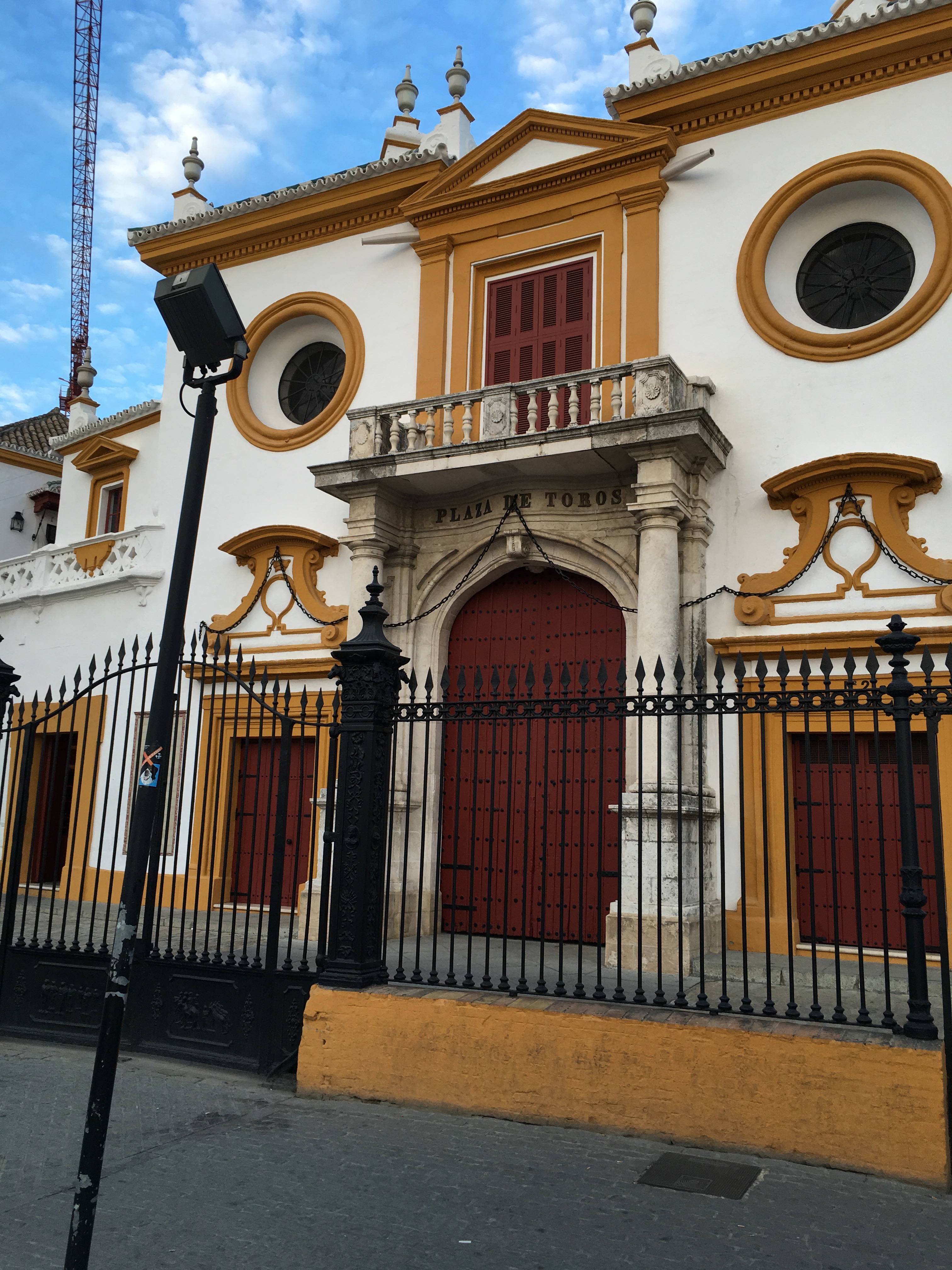
#87 Plaza de Toros: An Andalusian Childhood
Sometimes I compare my early childhood to that of my friends, my wife, or members of my band, and marvel at how unusual my experiences were, especially my memories of Spain. Sometime in the summer or fall of the year when the sea froze, my father returned from South Korea. He had returned to take us to Seville, Spain. My father, an NCO and specifically a Tech Sergeant in the U.S. Air Force, had received his next assignment. He was part of a small detachment of U.S. Air Force personnel assigned to a Spanish airbase just outside Seville. This airfield is now the commercial airport for Seville, but at that time, it was called Santa Clara.
Unlike the larger U.S. airbase nearby at Morón, there was no on-base housing for us. Instead, we lived in a small development on the outskirts of Seville, next to the Coca-Cola plant. We were not fenced off from the local population as many service member families are in other parts of the world. We were constantly in contact with the locals. Peddlers with their carts were always up and down the streets of our neighborhood, selling not just food and household wares, but also offering various services. Seamstresses, cobblers, knife sharpeners, and even a doctor with two nurses in a sort of ambulance came through offering their services.
Spain was very poor at the time, and the wage disparity was so great that even on a Tech Sergeant’s salary, we could afford a housekeeper. We called her Gracias, but that was just the first word of a very long and unusual name, an entire sentence that began with Gracias. The name was the result of some sort of religious vision her mother had; that’s all we knew.
Fittingly, Gracias was very helpful to my mom since my oldest sister, Sandra, was born with cerebral palsy. Although her case was relatively mild, our household always needed a little help (more on this in “Tell Me How Does Your Sister Roller Skate”).
Gracias would play the local radio while she helped out around the house. Mostly, what was played in those days were traditional Andalusian Sevillanas and sometimes pure Flamenco. Sevillanas while similar to Flamenco are more like traditional folk or pop music, while Flamenco, being more improvisational, is edgier and wilder, more like jazz. At least that was the way it was regarded in those days.
My parents, like many military couples, were already deeply into music, mostly American country, blues, and rock. I guess it was the thing that kept them connected to their homes. (My mom, growing up next to a U.S. airbase, was deeply familiar with American music from a young age and regarded it as her native music as well.) Gracias brought Andalusian music into our house. My parents were always quite open-minded when it came to music, culture, and food, and they quickly adopted Flamenco and Sevillanas into their LP rotation.
The Feria de Abril is a giant fair held in Seville each April, where Sevillanas music and dance have become synonymous with the festival. Gracias and my mom made traditional dresses for themselves and my sisters, blending in completely with the locals each April. My two older sisters and my mom even learned a few of the dances. As my mom would say, “we went native.”
My mom had a knack for adopting local accents. Unlike your friend who spent a semester at Oxford and returned to Morristown, NJ, with a slight British accent, my mom’s American accent was flawless. Growing up in the States, most people didn’t realize she was English. When we lived in Spain, Gracias and her friends didn’t realize my mom was English either. When they found out, they suddenly had an urgent story to tell her. Apparently, an Englishman regularly appeared in the local park in the evenings wearing women’s clothing. “Is it a plaid skirt?” My mom asked. Gracias and her friends conferred and said yes, it was a plaid skirt, although they seemed a little unsure. “That’s a Scotsman,” my mom told them. “That is their traditional dress.”
A few weeks later, my mom happened to be in the park with Gracias, and they saw “The Scotsman,” who turned out to be a full-on drag queen. Although his long skirt could be described as plaid, it was not a kilt. “Gracias, that is not a Scotsman. That is an Englishman in a dress.”
While everything I describe sounds delightful, there was also a dark edge. Bullfights, a cruel sport, permeated this beautiful region of Spain. The imagery was everywhere—paintings, carvings, even on china. Bullfights were televised, and my dad would set up the TV in the courtyard for families to watch. We had toy bullfighting sets and even a children’s book, Little Egret and Toro by Robert Vavra. The story follows a cattle egret who warns a bull about the dangers of the bullring. During a crucial moment, the egret and his friends fly around the bullring, causing the matador to mistake them for white handkerchiefs and spare the bull. Although the book was meant to soften the brutality of the sport for children, it had the opposite effect on me, humanizing every bull. Even egrets made me sad, as I imagined each one had lost a bull friend in the Plaza de Toros.
I remember waking up
To the bright sunlight
Streaming through the blinds
From the courtyard rose Sevillanas
And American rock and roll
My father in his Sunday best
Played records for his friends
I tasted sangria from a half full cup
And my sister slapped my hand
Then we followed on
The swelling crowd
To the Plaza de Toros
Now come the picadors
The crowd gets to their feet and roars
Papa do they really kill the bull?
Then comes the matador
Behind his back a gleaming sword
Papa do they really kill the bull?
This all happened while Franco was still alive and governing Spain. Sometimes I hear my friends say things like “we are becoming a fascist country,” and I feel like slapping them. While I may not like the direction of our politics, we are not a fascist country. It’s funny, but I guess you could say I grew up in a fascist country. I was young and an American with a U.S. Air Force family, so I was mostly isolated from the brutality. But even I wasn’t completely insulated. The Coca-Cola plant next to our neighborhood went on strike, and the Guardia Civil, Franco’s paramilitary police, were brought in to put it down. It must have been the summer of ’67, during the so-called Prague Spring. There was unrest all over Europe, and even under Franco, there was unrest in Spain.
One day, I was in the old city with my mom. We were shopping when a demonstration began—possibly another labor strike. People were marching and chanting. The city police or Guardia Civil suddenly appeared, and people started running. A shopkeeper motioned us into his shop and rolled the metal door down as the chaos increased outside. We sat there listening to people shouting and police with bullhorns. There were also shots fired; I don’t know if it was tear gas, rubber bullets, or live rounds. But I wasn’t scared because the adults around me were acting normal. The shopkeeper asked me about my toys and fed me sweets. We were rarely allowed Coke, but the shopkeeper gave me a full bottle. My mom, who grew up watching German bombers fly over her house, was laughing and making jokes with the shopkeeper.
In the ancient streets
Of the old city
Comes a marching crowd
In unison
They chant and sing
Hold their placards in the air
The shopkeeper motions
Quick come inside
Then he rolls the shutters down
(And then) the shots ring out
The men run and shout
The old man gives me a coke
We emerged at dusk
And the water in the street was pink
Mama do they really kill the bull?
Then I thought I saw the matador
He held up high a gleaming sword
Papa do they really kill the bull?
Next to the Coca-Cola plant and directly across the street from our house was a field littered with the rubble of an old building. It fascinated the neighborhood boys, as there were all sorts of treasures to be found: a rusty iron bar, a piece of melted glass, a sprocket from an industrial machine. One sandy area yielded numerous finds, making it a favorite spot to dig. We discovered a large ornamental metal button from a coat one day, something that looked like a blade another day, the metal rim of a wheel, and part of an axle. Eventually, we found a belt that normally holds bullets. “A machine gun belt,” one boy said, holding it up triumphantly. An older kid disagreed, “It’s too small; it’s a bandolier.” There were no bullets in it.
Everyone started digging more, and someone unearthed a textured metallic cylinder with a wooden handle. A couple of boys were poking at it when an older boy screamed, “That’s a hand grenade!” We all ran off terrified, screaming for our mothers (our fathers were at the base). As we rounded the side of our house, we startled some Roma men who were stuffing sheets and clothing from our clothesline into the back of their cart. They took off running as well.
Someone’s mom called the base, and eventually, some MPs showed up with a work dog. The dog spent some time inspecting the field with his handlers. Eventually, the MPs put a couple of items into the back of their jeep but not before telling us to never go in that field again. We never did, not because we were afraid of the MPs, but because we were more afraid of our mothers. We never learned if it was a hand grenade.
Dug a hole in the ground
As boys often do
And we found a bandolier
And a German made
Hand grenade
From the Spanish civil war
Older boys came along
Said go back in the wheat
Too much danger to be near
And the Romany men
Looked on holding piles of sheets
And my mother’s blue green blouse
Then came the base MPs
The Romany slipped back into the wheat
Papa do they really kill the bull?
And always the Matador
Behind his back a gleaming sword
Papa do they really kill the bull?
+++++++++++++++++++
David Lowery: guitar and vocals
 300 Songs
Leave a comment